Friday, October 7, 2022

Demdike Stare and Jean Rollin's Nude Vampire

This is a revived version of a Line Out post about Demdike Stare's live score for Jean Rollin's La Vampire Nue (these posts were purged from the internet after The Stranger pulled the plug on their music blog).

FILM/TV Sep 26, 2012 at 12:47 pm

Demdike Stare and Director Jean Rollin

If you don't know much about Demdike Stare, who'll be returning to town for Decibel Festival 2012, Dave Segal lays it out for you here.

La Vampire Nue (1970) / Carnal Cinema

Earlier this year, in advance of their triple CD Tryptych, Segal described the British duo (Miles Whittaker of Suum Cuique and Sean Canty of Finders Keepers Records) as "English hauntological-post-techno illuminati," so who better to provide the musical accompaniment for 1970's La Vampire Nue from horror-kink master Jean Rollin? (Demdike made their Seattle debut at May's Psychic Circle Fest.)

Even if Whittaker rejects the term "hauntological," Demdike Stare's music isn't worlds away from the unsettling, cinematic sounds of Julian House's Focus Group or Leyland Kirby's Caretaker (and I couldn't recommend the Focus Group's collaboration with Broadcast, Investigate Witch Cults of the Radio Age, and the Caretaker's An Empty Bliss Beyond This World more highly). Though Kirby was originally scheduled to attend Decibel, as V/Vm, he's no longer part of the bill.

The best known Rollin feature film remains his first, 1968's The Rape of the Vampire.

As for Rollin (1938-2010), the French author, director, and porn auteur worked under his own name, as well as the aliases Michel Gentil, Robert Xavier, and Michel Gand. His specialties included vampires and naked ladies. Best title: Vicious Penetrations (four of his X-rated films feature the word "penetration" in the title).

Just as Whittaker rejects a term frequently associated with his work, Rollin rejected the term "horror," possibly because he wasn't as interested in scaring audiences as in seducing them by any means necessary (lesbian vampires were a particular favorite). He also rejected comparisons to equally prolific Spanish filmmaker Jess Franco, though they sometimes worked on the same projects.

Redemption-Kino Lorber / La Vampire Nue

Here's Rollin's own description of La Vampire Nue (The Nude Vampire):

By the time my second film rolled around I was a little wiser. I again succeeded in including certain images that were important to me: the men with animal heads; the curious drawing room-library I had rented on the Cours Perimony check, where I had a harp brought in. And a fantastic labyrinthine castle, where the naked vampire with orange veils, a candelabra in one hand, wandered.

I'm not familiar with the film, but I'm definitely curious. An IMDb user proclaims it "possibly the weirdest" of the eight Rollin pictures he's seen. Good or bad, it's sure to be...provocative, and I'm sure Whittaker and Canty have conjured up a suitably atmospheric score to accompany it. At the very least, Rollin didn't consider Nue the worst of his 42 (or so) films—that honor went to 1980's Zombie Lake.


Rollin prioritized the production of imagery over the direction of actors.

Demdike Stare re-score La Vampire Nue at Broadway Performance Hall today at 5:30pm. More info here. On Sept 27, they'll be part of the Modern Love Showcase with Andy Stott and Cut Hands at Melrose Market Studios. 

Stephen Kijak Profiles Unstoppable Japanese Metal Musician Yoshiki Hayashi in We Are X

This review originally appeared in Bob Ham's Portland film screenings newsletter Daily Projections on November 21, 2016.

WE ARE X 
(Stephen Kijak, 2016, USA/Japan, 101 minutes)

Over the years, a few Japanese acts have found some degree of American success, from Boris to Peelander-Z. Until recently, however, X Japan were their country's best kept secret. Now they're playing major US venues, but they're still hardly a household name. Stephen Kijak (Scott Walker: 30 Century Man) uses their 2014 concert at Madison Square Garden as a structuring device for a look back at their rollercoaster career. 

With their glam-punk "visual kei" image and thunderous metal sound, it's hard to understand why they didn't cross over sooner. Gene Simmons, a native Hebrew speaker, blames it on a reluctance to sing in English. 

In their early days, they looked and sounded like a symphonic speed-metal cross between Hanoi Rocks and Metallica. Kijak tracks their rise to fame along with the Badfinger-sized setbacks that befell them in the process. 


He concentrates primarily on soft-spoken band leader Yoshiki Hayashi. The drummer, composer, and producer grew up as a sickly child, but he excelled as a classical pianist. Losing his musically-inclined father to suicide when he was 10 years old, however, made him angry and suicidal until his mother bought him a drum kit on which to bash out his frustrations. 

Yoshiki formed X in his teens, signed to CBS/Sony at 20, and then pulled the plug in 1997 after singer Toshimitsu Deyama, aka Toshi, a friend since preschool, left to join the Home of Heart cult. Things would get worse in the years to come, so much so that fans rioted in the streets in response to the more tragic developments. Several even attempted suicide (three died). 

If the band's reformation has allowed them to finish what they started, Yoshiki, who performs in a neck brace due to excessive head-banging, admits that he's in constant pain from tendonitis, carpal tunnel syndrome, hyperthyroidism, and other ailments. During the course of the film, he visits a specialist and receives a series of pain-relieving injections. 

As in his Scott Walker documentary, Kijak offers no details about Yoshiki's sexual orientation or romantic history, which plays more like a decision than an oversight. If he recounted Jaco Pastorius's relationships in the very fine Jaco, co-directed with Paul Marchand, that may be because he didn't need the bassist's permission to make a film about him (authorized biographies of living figures often come with strings attached). Whether the androgynous Yoshiki is attached or otherwise, Kijak gives the impression that music takes up so much of his time that there's little room for a partner of any kind.

If Kijak's documentary hits a few familiar beats along the way, it's hard not to be moved by emotional footage of fans across the world finding solace and support in the absolutely unstoppable Yoshiki's life's work.


We Are X, a Drafthouse Films release, is available to stream through Google Play, YouTube, and other digital pay operators. Images from Drafthouse / The New York Times (Yoshiki Hayashi), RogerEbert.com, and Vudu.

Simon Amstell Charms with Semiautobiographical Love Story Benjamin

BENJAMIN 
(Simon Amstell, 2020, UK, 85 minutes) 

Loose and charming, standup comic-turned-director Simon Amstell's second film, after 2017 mockumentary Carnage, revolves around a character much like himself, a gay London director making a film about a gay London director (Amstell also served as host of BBC quiz show Never Mind the Buzzcocks). 

Though Benjamin's first film met with a positive response, he's been struggling with his second. Instead of another romantic comedy, he's decided to make something more ruminative. 

In the midst of the struggle, his exasperated publicist, Billie (Jessica Raine, Call the Midwife), offers a diversion by inviting him to a launch party for a chair. The minute he catches a glimpse of Noah (Phénix Brossard, Little Joe), French singer of the band hired for the event, he finds himself smitten.

Their first meeting is awkward as Benjamin (Irish actor Colin Morgan, Merlin) says whatever pops into his head, but the easygoing Noah doesn't seem to mind. When he asks what Benjamin has been working on, the director describes his latest project as a film about his "inability to love"--an autobiographical feature, in other words. 

Noah invites himself to Benjamin's oddly-shaped apartment, ostensibly to watch his first film, but a romance soon ensues (the apartment includes a fluffy tabby who appears to talk to Benjamin when he's at his lowest ebb). The next day, they eat porridge and trip on magic mushrooms. 

At the premiere of Benjamin's new film, the audience reaction is less than enthusiastic. He's crestfallen, if unsurprised. Noah, who is preparing to graduate from music school, says he likes it, but he chooses that particular moment to let Benjamin know that he isn't ready for a relationship. 

Casting about for a new project, Benjamin agrees to work on a script with Harry Barridge (Jack Rowan), the handsome, if vapid star of his film, but nothing productive comes from it. 

His love life, however, improves when he and Noah agree to try again, but after a disastrous dinner with Noah's parents when he runs into caustic old flame Paul (Nathan Stewart-Jarrett), the relationship founders again. Benjamin also worries about his friend, Stephen (Joel Fry, Game of Thrones), a standup who spirals into depression after a cringe-inducing gig. 

Amstell's film, which feels like the setup for a sequel, ends before Benjamin has decided on his next career move, but his personal life finally appears to be coming together. At its worst, the director's sophomore effort feels slight, but the laughs flow easily though deft dialogue and Morgan's crack timing, and Amstell dodges most of the clichés associated with the gay rom-com, like over-the-top gal pals and cartoonishly clueless parents. I enjoyed it.


Benjamin is available through Kino Lorber and free streaming through Plex and Tubi. Images from Channel 4 (Colin Morgan and Phénix Brossard), Film Cred (Jessica Raine, Morgan, Joel Fry), and Zeke Film (Morgan and cat).  

Saturday, October 1, 2022

Watch List: A Wrenching Indictment of Philippine President Duterte's Drug War

WATCH LIST
(Ben Rekhi, 2019, Philippines, in Tagalog w/ English subtitles, 94 minutes)

Filmmaker Ben Rekhi offers a wrenching indictment of the devastation President Rodrigo Duterte's drug war has wrought on the people of the Philippines. 

The story begins when cops round up dozens of suspected drug dealers in a Manila district, including Maria (Alessandra De Rossi) and Turo Ramon (Jess Mendoza). They're recovering drug addicts, and he's an ex-con, but they went straight once their kids came along. The cops take mug shots, collect urine samples, and enroll them in a mandatory rehabilitation program. 

The next day, Turo is killed on his way to work. Cops insist they weren't responsible, that there's no surveillance footage, and that Turo had meth in his pocket. Maria doesn't believe it. A cop named Ventura (Jake Macapagal) assures her they're trying to solve the case, but she's skeptical about that, too. Turo's death leaves her to fend for their three kids on her own, including 13-year-old Mark (Micko Laurente). 

From neighbor Hector (Lou Veloso), Maria learns that there's no way to get off the drug watch list. Once the state brands a citizen a dealer, they'll always be seen as a dealer. With no income coming in, she downsizes to a smaller shack, and tries to find a job, but no one wants to hire a dealer's widow. 

Out of desperation, she offers to work for Ventura. It's a risky proposition when the police force is rife with corruption. Ventura teams her with a mysterious figure named Torres (Manu Respall), tasking them to catch dealers in the act by pretending to be users or, in one particularly harrowing instance, a sex worker. It doesn't take Maria long to piece together what happened to Turo now that she's just like the people who killed him. 

While she struggles with her conscience, Mark starts hanging out with a friend, Joel (Timothy Malabot), who has become a dealer. A bright, observant boy, Mark tries to stay on the right side of the law, but the pull is strong. He also starts to figure out that his mother has gotten mixed up in something bad, but he isn't certain what it is. 

The conclusion leaves the tiniest glimmer of hope that things might get better someday, but it won't be anytime soon as this system, which is presumably designed to eliminate drug abuse, more effectively encourages it. 

The entire cast is strong, but De Rossi stands out as a woman who becomes everything she hates to provide for the people she loves. Rekhi, an American filmmaker, is aided immeasurably by cinematographer Daniella Nowitz's vivid camerawork. Not an easy watch, though consistently compelling, Watch List is one of the best anti-drug war films I've ever seen.


Watch List is available via Tubi. Images from The Manila Times (De Rossi), The New York Times (De Rossi and Respall), and Flickering Myth.

Monday, September 26, 2022

Photographer Jamel Shabazz Captured (and Continues to Capture) New York Cool

This is a revived version of a Line Out post about Charlie Ahearn's documentary, Jamel Shabazz: Street Photographer (these posts were purged from the internet after The Stranger pulled the plug on their music blog).

FILM/TV Sep 20, 2013 at 1:31 pm

Photographer Jamel Shabazz Captured (and Continues to Capture) New York Cool


JAMEL SHABAZZ:
STREET PHOTOGRAPHER

(Charlie Ahearn, 2013, 74 mins)

Jamel Shabazz: Street Photographer celebrates two of modern America's finest contributions to the world: street photography and hiphop culture.

As his barber friend, Tony, puts it, Shabazz's black and white and color photographs from the 1970s and '80s captured "life in its purest form." 

On the basis of the slightly faded, if arresting images that dance across the screen, he was also capturing style: Kangol caps, Puma kicks, Lee jeans, Double Goose jackets, and other markers of NYC cool.

Hiphop ambassador Fab 5 Freddy (TV Party, Yo! MTV Raps) describes Shabazz's subjects as "the cool cats on the corners on the street." 

In that sense, they remind me of the style photographs Amy Arbus, the daughter of Diane Arbus, took for The Village Voice in the 1980s and '90s, except Amy gravitated more towards the punk, new wave, and cabaret set. 

Shabazz also had a preference for subway backgrounds, which means that his photographs memorialize graffiti almost as much as they do people—along with the Radio Raheem-size boomboxes of yore.


Through the images, Shabazz talks about his life, his work, and the characters he met along the way. Interestingly, he started out by following the same path as his father, a naval photographer. 

After a stint in the military, Shabazz became a correctional officer at the infamous facility once name-checked by Jim Carroll, and didn't publish his work until the 1990s in Trace and The Source, which led to gallery shows, and the bestselling anthology, Back in the Days. (Soul singer Sharon Jones also worked as a correctional officer at Riker's Island before her music career took off. I suspect there's a lot of untapped talent in that world.)

Director Charlie Ahearn doesn't break the mold with this profile, which he bills as "a video," and nor is that his intention. He allows Shabazz to explain himself, so his subject sets the tone, but his respect for the man comes through loud and clear, and it's hard not to feel the same way in the presence of an inner-city historian who has so much love for the people who surround him—even the crack addicts, the prostitutes, and the juvenile offenders who ended up at his wing on Riker's.

Shabazz also maintains an interest in military veterans, Masons, and members of the Nation of Islam. As influences, he cites Malcolm X and photographer-turned-filmmaker Gordon Parks (The Learning Tree, Shaft). 

For all the talk of hiphop, though, the documentary is largely devoid of music—other than a few beats by Cresh Fraze and footage from a series of marching bands—and focuses more on regular folks than on celebrities, with the exception of speakers Bobbito Garcia, KRS-One, and Fab 5 Freddy, who also appeared in Ahearn's classic 1983 film Wild Style.

Jamel Shabazz: Street Photographer played at the SIFF Film Center yesterday (with Ahearn in attendance). DVD release TBA. Shabazz also appears in Cheryl Dunn's street photo survey Everybody Street.

Carnival of Souls: Dissolving the Line Between the Grind House and the Art House

This review originally appeared in Bob Ham's Portland film screenings newsletter Daily Projections on October 15, 2016.


CARNIVAL OF SOULS
(Herk Harvey, 1962, USA, 78 minutes

In one-feature filmmaker Herk Harvey's artful head-trip, Carnival of Souls, the line between the grind house and the art house bends and warps until it completely dissolves. 

The 1962 film, which wouldn't see formal release until 1989, starts like most youth-oriented pictures of the time as two thrill-seeking drivers race to see who can go the fastest, but when one car slides off a bridge and into the river, things shift into a very different register. The vehicle sinks beneath the water, and that appears to be the end of that. 

While the townspeople try to figure out how to dredge the car from the river, passenger Mary Henry (Candace Hilligoss, a cool blonde with a strangely sympathetic manner) emerges from the water, dazed but unharmed, claiming she has no idea what happened to her companions.


Afterward, she leaves Lawrence behind for a job as a church organist in Salt Lake City, necessitating a long drive through dark roads. Not least because of her job, to which she feels no Christian connection, the eerie music that swirls around her fits perfectly, especially when she starts to see a strange man (played by Harvey) who may or may not exist. 
 
The pale, spectral figure follows her to her new rooming house, conveniently located next to an abandoned carnival (Harvey used an actual location, the Saltair Pavilion, which was consumed by fire in 1970).

Aside from the intrusions of her boozy neighbor, Mr. Linden (Sidney Berger), her days are going fine until Mary exits a department store dressing room to find that no one can see her. The phenomenon only lasts momentarily, but it leads her to a psychologist who believes there must be a rational explanation. He also gets her to admit that she isn't looking for a boyfriend. No desire for male companionship? She must be nuts! 


The experience emboldens her to explore the depopulated carnival grounds, a mesmerizing sequence in which cinematographer Maurice Prather shoots Mary from every conceivable angle. She's a tiny figure in a cavernous room and a black shadow against the afternoon sun. 
 
In its desolate beauty, it's The Trial meets The Last Man on Earth (striking compositions compensate for clunky foley work). Though Mary emerges unscathed, the spirit of the carnival appears to have possessed her, so she keeps running and running and running until she can run no more. 

As with Charles Laughton, who invested The Night of the Hunter with Expressionist atmosphere, Harvey's only film left an indelible mark--George Romero claimed it as an influence on Night of the Living Dead

Mary's struggle against the dying of the light also takes on feminist form. As she tells Mr. Linden, "In the dark, your fantasies get so out of hand, but in the daylight, everything falls into place again," suggesting that she isn't just fighting to live, but to do so free from societal obligations.

It's hard to imagine female-fronted horror films, like Alejandro Amenábar's The Others or David Robert Mitchell's It Follows, without its precedent, but Carnival of Souls exerts a haunting, strangely affecting spell all its own. 
 

Carnival of Souls is available on DVD and Blu-ray through The Criterion Collection. Images from The Criterion Collection and Ciné-Histoire.

Saturday, September 24, 2022

Things to Come: A Work of Empathy from French Filmmaker Mia Hansen-Løve

This review originally appeared in Bob Ham's Portland film screenings newsletter Daily Projections on December 16, 2016.

THINGS TO COME
(Mia Hansen-Løve, 2016, France, 102 minutes)

Actress-turned-filmmaker Mia Hansen-Løve turned 35 this year, and Things to Come is her fourth feature, but while her last film, 2014's rambling Eden, explored the pleasures and perils of youth, her new film revolves around the trials and tribulations of a 63-year-old woman. 

Aside from the fact that the writer-director, the daughter of two philosophy professors, avoids the stereotypes usually associated with films about older women, Hansen-Løve prioritizes change over age, since many of the setbacks Isabelle Huppert's Nathalie experiences could conceivably afflict younger women, too (notably, Hansen-Love met her husband, 61-year-old director Olivier Assayas, when she appeared in 2000's Les Destinées).

During the course of the film, the self-possessed philosophy teacher suffers a series of losses when her husband, Heinz (André Marcon from Hansen-Løve's Father of My Children), leaves her for a younger woman and her glamorous, acidly amusing mother, Yvette (Édith Scob, who previously appeared in Assayas's Summer Hours), ends up in a retirement home where her already-perilous mental condition quickly deteriorates. 

Nathalie also tangles with a publishing company that wants to bastardize her textbook to boost flagging sales, but just when it seems as if things can't get much worse, they don't. Hansen-Løve has something more subtle and less wrenching than melodrama in mind. 

In a more conventional film, Nathalie might seek revenge on Heinz, find her own age-inappropriate lover, or start all over again in a new town. Instead, she reconnects with her former student, Fabien (Eden's Roman Kolinka), a fellow academic. When she complains to him, "After 40, women are fit for the trash," he strenuously disagrees.

Hansen-Løve suggests that there may be some degree of physical attraction between the two, but she never pushes that angle too hard. The tall, rangy Fabien shares a cozy home with friends in the remote Rhône-Alpes where Nathalie seeks refuge when Paris gets to be too much of a drag. In their warm, if slightly critical embrace, she finds a form of salvation. 

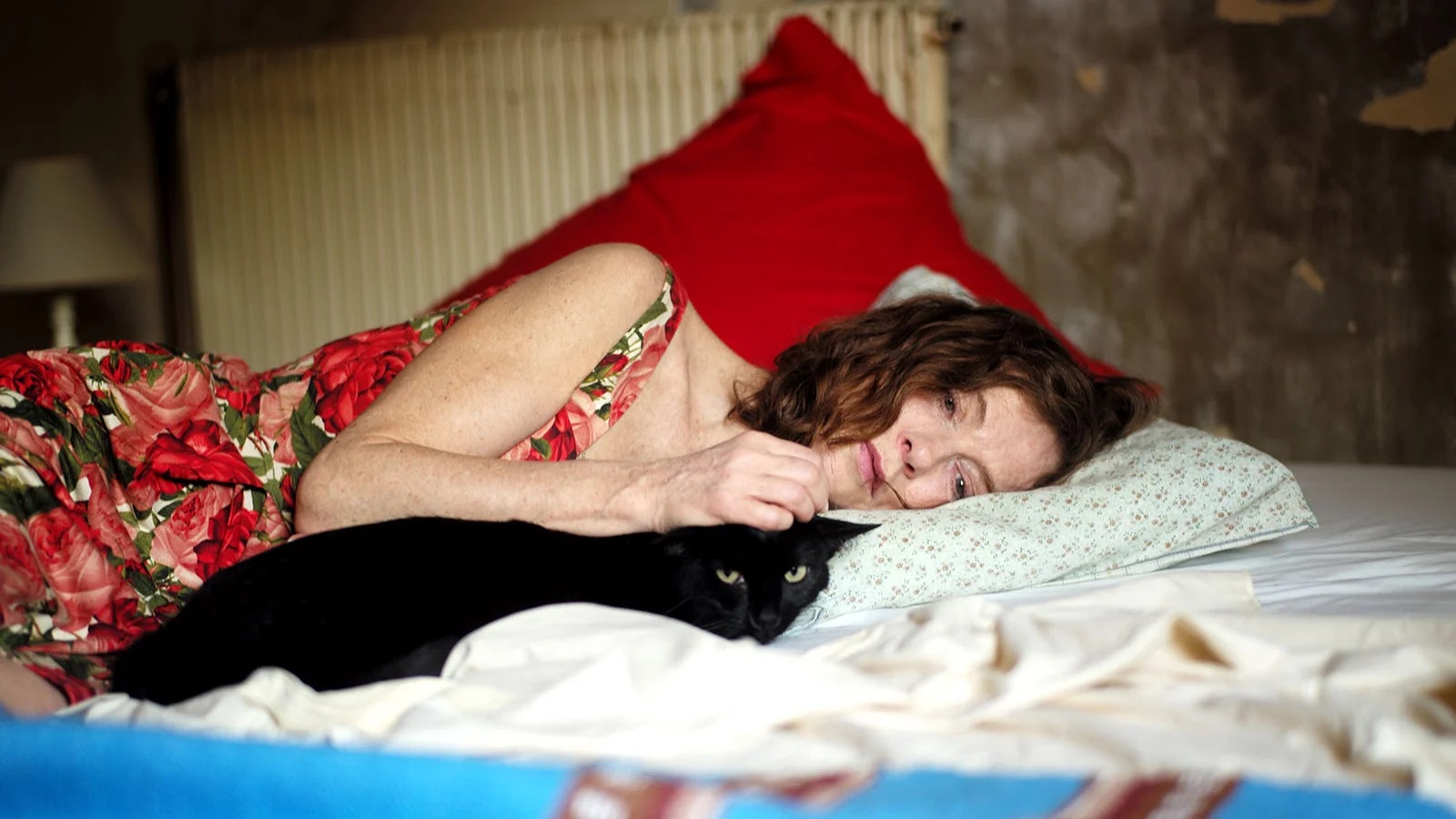
Unlike Paul Verhoeven's Elle, in which Huppert plays the victim of a violent attack, there's no mystery at play, but the actress commands the screen as easily as she has in the films of Claude Chabrol and Michele Haneke, whether Nathalie is cooing over a baby or stressing about a cat (her mother's beloved Pandora). 

In the press notes, Hansen-Løve, who wrote the part specifically for Huppert, states, "I rate her as the greatest French actress." At the film's outset, Nathalie asks, "Can we put ourselves in the place of the other?" It’s exactly what her director has done, and Things to Come is as much a work of empathy as a portrait of the kind of woman usually consigned to the margins of American cinema.


Images from Film Comment (Isabelle Huppert), the IMDb (Huppert and André Marcon), and TIME (Huppert and Roman Kolinka).