Saturday, April 23, 2022

"I Do the Rock": A Stimulating Study of the Song That Defined Tim Curry's Pop Career


Here is the text of the paper (and a portion of the slide show) I presented at the Pop Conference on April 23, 2022.

Full title: "I Do the Rock": 
A Stimulating Study of the Song That Defined the Pop Career of Musical Theater-Turned-Movie Star Tim Curry 

Dame Edith Sitwell, a Modigliani painting come to life, wasn't just a poet, but a lyricist, since she set some of her poetry to music. She would also perform these musical poems on stage behind a myriad of scrims. Further, she had a connection to Hollywood through her many famous silver screen admirers, including Charlie Chaplin and Marilyn Monroe, who set out to meet her when she visited California in 1950. 

On the personal front, Sitwell had a knack for falling in love with gay men, like Siegried Sassoon, who shared her love of art and poetry. Her brother, Osbert, was also gay. Sitwell would never marry. 

A decade from the stardom he would claim in the 1970s, aspiring actor and singer Tim Curry was 18 when Sitwell died in 1964. Fifteen years later, Curry would co-write and record a song, "I Do the Rock," that opens by mentioning the poet. But he went several steps further by citing her brothers Osbert and Sachie, also poets, in the same verse. How many listeners in 1979 actually recognized those names? 

According to The Oxford Dictionary of National Biography, the Sitwell siblings "drew inspiration from the commedia dell'arte and the Ballets Russes, from Pope and Swift, from Dickens and D'Annunzio, from Claude and Marinetti, from the baroque and chinoiserie. Frequently attacked as enfants terribles, they were none the less widely admired, especially by Evelyn Waugh, who paid them a supreme compliment when he proclaimed: 'They took the dullness out of literature'."

I was 15 when I first heard "I Do the Rock," and the names of the Sitwells sailed right over my head. Granted, I was also unfamiliar with Gertrude Stein and Alice B. Toklas who join them in the first verse.

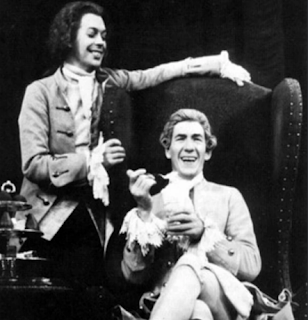
So, what connects these public figures, beyond their nationality and striking bearing? As a young performer, Curry would join a band of English eccentrics, like Rocky Horror Show playwright and actor Richard O'Brien, who shared characteristics with their poetic predecessors, including a predilection for eye-catching outfits, a love of wordplay, and a delight in shocking straight society. Sitwell and her tribe helped to sow the seeds of glam, glitter rock, and even the more flamboyant stage plays, like Peter Shaffer's Amadeus, for which Curry would play the title role in the 1980 Broadway premiere. 

The previous year, he released his second album for A&M, 1979's Fearless, which included the singles "I Do the Rock" and "Paradise Garage." The videos for these songs would appear before screenings of The Rocky Horror Picture Show. At that time, MTV was still two years away from inception. 

I should backtrack for a moment here to note that Fearless was actually Curry's third album, because his 1976 debut, now known as …From the Vaults, wouldn't see release until 2010. Grammy Award-winning producer Lou Adler, an executive producer of 1975's The Rocky Horror Picture Show, handled production duties, and the results are surprisingly strong for an unceremoniously shelved release, especially Curry's kicky, piano-driven cover of John Phillips and his wife Geneviève Waïte's "Biting My Nails," which would become a dancefloor sensation, by way of a radically different arrangement, for British electronic act Renegade Soundwave in 1989. 

Adler's production duties for the Mamas and the Papas in 1968, in addition to Phillips' 1969 solo release John Phillips (John, the Wolf King of L.A.), helps to explain why Curry covered yet another Phillips composition, "Just Fourteen," on the same album. The song, featuring backing vocals from Brian Wilson and members of the girl-group the Honeys, was released by Adler's A&M imprint Ode Records as a single in 1976. It represents Curry’s first official studio release. 


Fearless, which reached #53 on Billboard's US 200, followed 1978's Read My Lips. Curry would issue his third and final official pop album, Simplicity, in 1981. It produced no charting singles and led to the end of his contract with A&M. Though "Paradise Garage" wouldn't chart in the US, "I Do the Rock" marked Curry's sole entrance, as a pop performer, on Billboard's Hot 100 when it peaked at #91 in 1979. 

If his three other studio albums, including …From the Vaults, consisted primarily of covers, Curry turned to Michael Kamen and Dick Wagner, with whom he had worked on Read My Lips, as producers and writing partners for Fearless. At the time, Wagner was best known for his work with Alice Cooper, Lou Reed, and KISS, while Kamen had also worked with a number of prominent recording artists, most notably David Bowie, for whom he had served as arranger and multi-instrumentalist on 1974's Diamond Dogs Tour. Kamen's career as an Oscar-nominated movie composer, however, wouldn't kick into overdrive until a few years after his work with Curry. Kamen, 55, died of a heart attack in 2003.

Oddly, A&M would promote Fearless as the work of a neophyte, rather than that of an experienced singer, even though Curry had been performing professionally since at least 1968 when he joined the London cast of Hair. That was the point at which he met O'Brien of future Rocky Horror fame. 

As A&M's promo pack for Fearless would have it, "Curry is no long-term rock and roller who thrashed out Chuck Berry songs at sock hops in high school. He entered the form untrammeled by the weight of its traditions and has conquered it through the force of his own wit, intelligence, and panache. His first album, Read My Lips, was the work of a talented innocent who put himself in the hands of an acknowledged master, Bob Ezrin. Fearless is much more than simply an improvement. It is, instead, a quantum leap to a whole new level of creativity and involvement. Curry wrote no songs for his first album: on this latest release, he's written words for six of nine." The album's sole non-original is a cover of Joni Mitchell's "Cold Blue Steel and Sweet Fire." Notably, he also covered Mitchell's "All I Want" for Read My Lips, so he was clearly a fan of the Laurel Canyon legend, even if his style and hers don't quite mesh. 

As before, Kamen and Wagner played in the band assembled for the recording, which took place at New York's Hit Factory and Massachusetts' Long View Farm Recording Studio. Kamen is credited with piano, oboe, and synthesizer and Wagner with lead and acoustic guitar. David Sanborn, a year away from his first #1 jazz album, 1980's Voyeur, provided the obligatory New Wave sax. In his All Music Guide review of Fearless, outsider musician Eugene Chadbourne describes Sanborn's playing as "slurpy," adding that it is "thrust in thy face like a jumbo-size drink of the same distinction."

In A&M's promo pack, Curry goes on to explain the thinking behind his writing, "I've always had scripts before, but now I'm blundering toward what I feel. The idea is to progress toward some kind of honesty." 

It's my belief that Curry wrote all or most of the lyrics that make up "I Do the Rock" and that Kamen wrote all or most of the music. There's no reason why an American like Kamen wouldn't have some familiarity with the British figures, except they tend to be a little more obscure than the American ones, like "Best," a reference to footballer George Best, and "Meg," a reference to Princess Margaret. That said, Curry and Kamen were born only two years apart, so the list is just as specific in a generational sense to both men. 

Over the years, the name-heavy song has been compared to Jim Carroll's "People Who Died," Billy Joel's "We Didn't Start the Fire," and R.E.M.'s "It's the End of the World as We Know It (and I Feel Fine)." 

During the course of four minutes and 51 seconds, Curry cites 46 public figures, divided into five sections involving literature, music, politics, sports, and gossip. That's a fairly tidy description of a song that's actually a little messier than that, but it would take hours to discuss each figure, so I won't—and I'm not sure that I even could--but I began by mentioning Edith Sitwell, because she struck me as the least obvious figure with which to open a pop song, and also possibly the one closest to Curry's heart. 

Even assuming that he was wholly responsible for the lyrics, though, I make no claims that "I Do the Rock" is telling us exactly who he was in 1979, or even now at the age of 75, but rather that it was an expression of his interests at the time, and an indication of the kind of songwriter he could've become if given sufficient encouragement to hone his skills. Instead, he leaned primarily, but not exclusively, on cover songs for his final album before packing in his pop music career for good. 

In 1980, he told The Washington Post that he didn't have anything left to say. As he put it, "I'm proud of the records--they had three or four good songs, which isn't bad… But frankly, it just got too hard. I did like 100 cities in America, I did a continental tour, I worked with studio musicians, did one-night stands--the most exhausting way of living known to man. By the time I got round to the third record, I didn't really feel that what I had to say was going to be heard, or particularly worth saying. So I quit."

Because Tim Curry has always kept his private life private, I scoured the lyrics on all four of his albums for clues, specifically regarding his sexual orientation, but came to no definitive conclusions. Though he claimed, in 1979, to be progressing toward honesty as a songwriter, that's one area where he remained opaque, and he has continued to take the same approach in interviews, in which he otherwise comes across as quick-witted and self-deprecating--an extension, if you will, of the persona he projects in "I Do the Rock." 

Nonetheless, I've always believed that even the most private artists tell us who they are through the songs they sing and the roles they play, not necessarily individually, but collectively, and Curry has consistently avoided traditional masculine leading roles. As he once told People magazine, "I like risky parts--abrasive characters the audience won't necessarily like." 

That was as true of the auteur-driven films and plays he did in the UK in the 1970s, like Dennis Potter's Schmoedipus and Jerzy Skolimowki's The Shout, as the commercial projects he did in the US in the 1980s, like Ridley Scott's Legend, for which he underwent a laborious makeup process to play the demon Darkness, and my personal favorite, Alan Moyle's teen runaway saga Times Square, in which he plays a rabble-rousing disc jockey.  

In 1988, Curry relocated to the US from Britain. Though he experienced a major stroke in 2012 that has made it difficult for him to continue with the more rigorous stage and screen roles of his past, he's kept busy with voice work and public appearances, particularly those involving The Rocky Horror Picture Show. Like Edith Sitwell, he never married, but he has known love. All he'll say about that publicly is that it didn't last. 
When all is said and done, Tim Curry will be best remembered for Rocky Horror. He was the first actor to play Dr. Frank-N-Furter, and he even made suggestions that original London director Jim Sharman incorporated into the stage production. 

Though I was among the young and impressionable audience members who saw it several times at midnight screenings in the 1970s and '80s, I've never assumed that Curry was that character, but it drew on his strengths as an actor, as a vocalist, and as an unconventional sex symbol in a way that made him an LGBTQ icon. As culture bloggers Tom & Lorenzo put it in a celebratory 2020 blog post, "In many ways, The Rocky Horror Picture show represented one of the biggest cultural triumphs of the queer art community immediately post-Stonewall." They go on to note that "Curry's Frank N. Furter provided a shocked public an image almost none of them had wrestled with prior to 1975: the image of a pansexual non-binary figure who was hot and down to fuck." 

If Curry remains proud of both play and film, it's overshadowed much, but certainly not all, of the work he's done since. Significantly, he originally saw his pop career as a way to get away from Rocky Horror and to create a new identity. That's why he refused Lou Adler's suggestion that he cover Burt Bacharach and Hal David's "I Say a Little Prayer" on his debut with its proto-Rocky Horror couplet, "The moment I wake up, before I put on my makeup."


It's my hope that Curry's pop career, brief as it was, will also be remembered. When A&M released The Best of Tim Curry in 1985, they did their bit to help the cause. Joked Curry at the time, "They couldn't call it the Greatest Hits, because there weren't any." Funny line, but it isn't quite true. 

If "I Do the Rock" was his best song, and indisputably his most popular, it wasn't his most personal. Oddly, the most personal wasn't written by Curry at all, but rather by Bob Ezrin and Michael Kamen, and it appears on Read My Lips. In "Sloe Gin," he sings, "I'm so fucking lonely and I ain't even high/I'm so fucking lonely and I feel like I'm gonna die." It's possible that this nakedly emotional lament simply represents a role that Ezrin and Kamen created for Curry, but when he sings the lyrics, you believe him. 

In a development typical of Curry's pop sojourn, guitarist Joe Bonamassa would title his sixth studio album, which topped Billboard's blues chart, after his expletive-free cover of the song. "Sloe Gin," which Curry had originated nearly 30 years before, would become one of Bonamassa's signature numbers. 

When Tim Curry tells us in "I Do the Rock," that that's all he can really do, he sells himself short. Maybe he was just playing the role of a rock & roll star, but he could, and did do, a lot more. And I'm glad he did. 

And now here's the video for "I Do the Rock." Thank you for listening. 

 
Images: 1) Tim Curry / photographer unknown, 2) Edith Sitwell with her brother Osbert in about 1920 © Hulton-Deutsch Collection / Corbis  via Getty Images, 3) Edith Sitwell, English Eccentrics, Faber & Faber, 1933 Penguin Books, Ltd, 1971 / Vulpris Libris, 4) Richard O’Brien and Tim Curry at the 1974 Evening Standard Theatre Awards, Evening Standard / Hulton Archive / Getty Images, 5) Read My Lips (1978) / Wikipedia, 6) Michael Stipe as Dr. Frank-N-Furter, circa 1978 / Flustered Mustard Theatrical Productions, St. Louis, MO, 7) Tim Curry as Robert Graves in Jerzy Skolimowski’s The Shout, 1978 / Films Incorporated, 8) Tim Curry and  Ian McKellen in Amadeus, circa 1981 / photographer unknown, and 9) Tim Curry as the narrator in FOX’s The Rocky Horror Picture Show, 2016.

Thursday, April 14, 2022

Boris Karloff vs. a Man in a Fur Suit in The Ape

THE APE 
(William Nigh, 1940, USA, 62 minutes) 

In 1940, when he starred in The Ape, Boris Karloff (The Old Dark House) was fresh off a run of William Nigh-directed capers for Monogram in which he played Chinese detective Mr. Wong. What seems culturally insensitive today was common at the time, since other non-Asian actors, like Warner Oland and Peter Lorre, played Charlie Chan and Mr. Moto. 

Fortunately, this poverty row picture is unburdened by dubious casting decisions, though it has other problems, owing more to its low budget and quick turnaround time. Karloff, the biggest name in the cast, plays Dr. Bernard Adrian. A loner by nature, he's only close to two people, his silent housekeeper (Gertrude Hoffman) and his "make believe daughter" Frances (Maris Wrixon), a sweet wheelchair user who reminds him of his late daughter. Though the script, loosely adapted by Richard Carroll (Five Came Back) and Curt Siodmak (The Wolf Man) from Adam Shirk's stage play, never uses the word polio, it's clear that Frances suffers from the infliction. 

Dr. Adrian is busy working on a cure when the circus comes to Red Creek (actually, Santa Clarita). Its star attraction, surly ape Nabu (B-western star Ray "Crash" Corrigan in fur suit), has just about had enough of his abusive trainer. The minute Nabu gets his paws on the man, he attacks him and makes his escape. Circus workers bring the injured trainer to Dr. Adrian, but the physician prioritizes the extraction of spinal fluid over the saving of his life. 

When the ape claims another victim, boorish banker Henry Mason (Philo McCullough, They Shoot Horses, Don't They?), Dr. Adrian adds more spinal fluid to his serum, but it isn't enough. Frances regains feeling in her legs, but she's still unable to walk. At this point, things get murky, because the simian escapee continues to ravage the rural burg, but Carroll's screenplay doesn't reveal the connection between the ape and the doctor until the very end, and even then it doesn't make as much sense as it should. 

In an effort to keep down costs, director Nigh incorporated footage from 1938's Under the Big Top for the circus montage in the opening and in an aerial performance that brings several characters together, including Frances, her fiancé Danny (Gene O’Donnell), and Henry and his mistress. Most of the material fits in pretty well, but the underdeveloped scenario makes it feel as if the ink wasn't quite dry on Carroll's pages before Nigh began to shoot. 

Fortunately, Karloff convinces as the well-meaning, if mentally unhinged medical researcher and the supporting cast offers solid support, especially Wrixon as a young woman who shows her surrogate father more kindness than her nosy neighbors can muster--before he goes off the rails, that is. 

Extra features include trailers for three Karloff films and separate commentary tracks from film historians Tom Weaver and Richard Harland Smith. If neither gent seems wild about the film, they provide a wealth of information about the production and its place in Karloff's long career. 


A new 2K Master of The Ape is now available on DVD and Blu-ray from Kino Lorber. Images from Vintage Geek CultureScifist 2.0, and eBay.

Wednesday, March 16, 2022

Talkin' 'Bout That Outlaw X: Ti West's Body Horror-Cum-'70s Slasher Picture

(Ti West, USA, rated R, 2022, 105 minutes) 

At its most basic level, the slasher film revolves around sex and death. By building his '70s-style horror picture around a pornographic film shoot, Ti West (The House of the Devil, The Innkeepers) makes the connection between the two more explicit--pun intended--than usual. But wait, there's more! Sex isn't subtext in X: it's text

The action takes place in 1979 as a van full of adult film performers and crew members head towards a rental property somewhere outside of Houston, TX. If that sounds like a twist on the set-up behind Tobe Hooper's immortal Texas Chain Saw Massacre (1974), I can assure you that it is. 

There are few, if any, coincidences in Ti West's eight-feature filmography. If you think you've seen something before, you probably have, but the filmmaker has a knack for making his borrowings feel new. Beyond the van full of youngish people and the sun-blasted landscape, the gang passes a dead cow, en route to their destination, in the wake of its evisceration by truck. Not only is it a harbinger of things to come, but the mess of blood and guts evokes the abbatoir milieu of Tobe Hooper's film. Granted, there are no slaughterhouse workers in X, but the film does have a couple of leathery-faces… 

Wayne (The Ring's Martin Henderson), the porn film producer, had made arrangements with Howard (Stephen Ure), the property owner, before he'd met the guy or seen the place. It was a different time--no cell phones, computers, or internet searches. Had Wayne taken advantage of any of those tools, it's likely he would've made alternative arrangements, because Howard is one weird and creepy dude. He's also very, very old. 

The producer, a relentlessly optimistic type, doesn't let it get him down. He plans to shoot the film in the ranch house attached to the stable, and then split the scene. 

His companions include two couples: leggy blonde performer Bobby-Lynne (a very game, very funny Brittany Snow) and the laidback Jackson (actor and musician Kid Cudi) and junior director RJ (The Americans' Owen Campbell) and boom operator Lorraine (You's Jenna Ortega). Wayne's girlfriend, auburn-haired performer Maxine (Nymphomaniac's Mia Goth), rounds out the troupe. He believes the freckled coke fiend has "the X factor" that separates run-of-the-mill adult film performers from superstars. 

While the gang shoots a scene with Bobby-Lynne and Jackson, Maxine decides to take a dip in the lake. As she floats on the water, an Ophelia in the sun, a hulking alligator eyes her hungrily. It's another harbinger of things to come, but she has no clue. She slips back into her overall cutoffs, but before returning to the ranch house, she stops by Howard's home, beckoned by the ghostly figure at the door. It's his wife, Pearl, an elderly wraith (played by a certain unbilled actor) who looks at Maxine with a mix of curiosity, jealousy and…something else. She shows her faded photos from when she was young and pretty. Her whole life was ahead of her. Now it's not, and there's a sense that Maxine is a very unwelcome reminder. 

The young woman eventually takes her leave. She's rattled, but unharmed. The shoot continues, but it's increasingly clear that the younger people are being watched--and judged--by the older ones. The fire and brimstone televangelist (Simon Prast) constantly ranting from Howard and Pearl's B&W living room TV provides a glimpse into their Old Testament mindset regarding premarital sex (the film's cruel joke is that, though married, they're too decrepit to act on their sexual desires). Once things start to go wrong for Wayne and the gang, they go hilariously, disgustingly wrong.

West, who also wrote the script, co-edited the film with David Kashevaroff, and their cross-cutting creates a destabilizing effect. It's subtle at first before becoming faster and more insidious. The jump scares also prove incredibly effective; some of the best I've witnessed since Jennifer Kent's The Babadook. A haunting, choral-based score from Chelsea Wolfe and The Sacrament's Tyler Bates contributes to the film's dangerously sexy vibe, bolstered by FM staples from Blue Öyster Cult, Robert Palmer, and the like.  

By the end, West has put his own "porno chic" spin on the '70s slasher film, with all the requisite toplessness, but he's also made a horror film in which the scariest thing isn't a rusty nail or even a hungry alligator, but an aged human body. He's hardly the first director to do so, since Tony Scott, M. Night Shyamalan, and numerous others got there before him, but the combination of sex and old age--let alone the combination of sex and death--creates a particularly queasy kind of tension. You could call it ageist, and you wouldn't be completely wrong, but it sure got under my skin.

X opens on Friday, Mar 18. A prequel, Pearl, shot around the same time, is expected later this year. Images from A24, Fangoria, and Indiewire

Saturday, March 12, 2022

They Got Him on the Run: Alien Boy Documents a Too-Short, Long-Remembered Life

I recently rescued this review, which was originally posted at The Stranger. It's from March 11, 2014.


Alien Boy, winner of the best film award at the 2013 Local Sightings Festival, begins with references to Portland bands like Poison Idea and the Wipers, but it isn't a music film. It's a documentary about police brutality and mental illness, since subject James Chasse, also known as Jim Jim, suffered from schizophrenia, a condition that inadvertently contributed to his tragic death. 

According to his parents, Chasse had a normal childhood until junior high, when things started to get weird. But music was a solace. He sang in a band and started a fanzine, The Oregon Organizm, to which notable writers like Joe Carducci (Rock and the Pop Narcotic) contributed. Chasse's girlfriend remembers that he would wear whatever he wanted, including women's clothing, for which he would get beaten up. It didn't deter him, but the demons in his head were another matter, and his behavior became erratic.

When Chasse told Greg Sage of the Wipers that he felt like an alien, the singer turned that admission into the song "Alien Boy" (it's fitting that Kurt Cobain shows up, via archival footage, as it's hard not to hear Nirvana's origins in that adolescent snarl and bass-heavy rhythm), but the Wipers connection ends there. 

Chasse maintained his friendships as best he could, but while his associates were finding their way in the world, he ended up in a mental institution and a series of group homes before eventually reentering society. Independence came with a price. When he neglected to take his meds, he would stop bathing, soil himself, and face rejection from the local establishments in which his parents, James and Linda, would attempt to catch up with him. They appear to have done all they could, but things would only get worse. 

And that's what happened: things went from bad to horrific when an arrest for suspected public urination turned lethal. The cops used excessive force and Chasse, who didn't receive appropriate medical treatment, died in police custody. The Oregonian and The Portland Mercury documented the ways police failed Chasse, including the untruths they told his family (former Mercury news editor Matt Davis appears in the film). It’s all pretty grim. 

In contrast to the officers' testimony during the ensuing court case, photographic evidence and surveillance footage—including disturbing audio—confirm that they acted inappropriately. Chasse may have run from the authorities, but he wasn't combative, he wasn't armed, and he wasn't on drugs. He died in 2006, but the findings of the internal affairs investigation wouldn't be released until 2010, while the family's lawsuit against the police bureau wouldn't be settled until 2011. 

As Linda puts it, "He didn't ever get to live the mainstream life of an average American man." All those avenues—college, a music career, a home of his own, etc.—ended when his illness kicked in. Consequently, there wasn't as much music content in this documentary as the title had led me to believe, but there's value here for viewers interested in the intersection of the police, their training, and the way we treat the mentally ill. At the very least, Chasse's death has helped to inspire change in the city of his birth. 


Alien Boy plays Northwest Film Forum through Mar 13 (no 9pm show on Mon). Breaking Glass plans to release the film on home video later this spring. Images from Oregon Live, Mental Health PDX, and PDX Monthly.

As it turns out, this review is still available on The Stranger website; I thought it had disappeared. Consider this a slightly expanded edition.  

Wednesday, March 9, 2022

Surrealistic Spies in Switzerland: Jean-Louis Roy's The Unknown Man of Shandigor

THE UNKNOWN MAN OF SHANDIGOR / L'Inconnu de Shandigor 
(Jean-Louis Roy, Switzerland, 1967, 96 mins) 

With this stylish Cold War satire, Swiss filmmaker Jean-Louis Roy crafted his own unique Dr. No-meets-Dr. Strangelove hybrid. Nominated for the Palme d'Or, yet unjustly neglected for decades, the loopy results play more like one of those mod '60s films that inspired Austin Powers--say, The 10th Victim--than a big-budget Bond production. And that is definitely not a complaint.  

Roy, who cowrote the screenplay with Gabriel Arout and Pierre Koralnik (director of the hard-to-find Serge Gainsbourg musical Anna) alternates between French, Russian, and American operatives. He starts by introducing a grumpy, aquiline-nose man in a wheelchair, Professor Von Krantz (The City of Lost Children's Daniel Emilfork, looking a little like Miguel Ferrer), inventor of The Canceler XII3, a contraption that neutralizes atomic weapons. 

Though reporters clamor to interview the Professor, he can't be bothered, snapping at one rather large fellow, "You are a walking blob of sperm!" The widowed scientist shares an under-furnished, modernist villa with his albino assistant, Yvan (Marcel Imhoff), and his beautiful blonde daughter, Sylvaine (Marie-France Boyer, Agnès Varda’s La Bonheur), who attends to his every need. 

Another gent with a distinctive visage, actor-musician Serge Gainsbourg, clad in black suit and leather gloves, plays Le Chef des Chauves, the combination spymaster and music director of a band of bald musician spies clad in pseudo-beatnik outfits. In a particularly amusing sequence, one baldie instructs the others on the art of the disguise, except his personas--"a tragedian," "a duchess," etc.--are anything but inconspicuous. 

If The Unknown Man of Shandigor revolves around the futility of war, it's also a treatise on surveillance. Just as the spies, including Howard Vernon's Bobby Gun (great name), a Nazi-turned-American agent, train their sights on the villa, the Professor and Yvan spy on Sylvaine. In other words, they may be on the side of good, but they're not necessarily good people. (For those unfamiliar with the prepossessing Vernon, his amazing filmography includes Jean-Pierre Melville's Le Silence de Mer, Jess Franco's The Awful Dr. Orloff, and Jean-Luc Godard's visually similar Alphaville.) 

While the spies try to figure out how to swipe the Professor’s plans, Sylvaine pines for Manuel, a trench coat-clad figure from her past (played by Ben Carruthers from John Cassavetes' Shadows). Her possessive, controlling father seems glad that he disappeared from her life, but Sylvaine can't let it go. When she attempts to reunite with Manuel, the baldies spirit her away. 

Left alone in an unsecured beach house, Sylvaine makes her escape to the mythical Shandigor (represented by the storybook structures of Antoni Gaudí) to find Manuel. If it wasn't clear by now, the baldies are far more skillful at music-making than spy-craft. As for the increasingly unhinged Professor, he's convinced she'll return, and she will, but not for the reason he thinks, i.e. that she can't live without him. 

Along the way, the various factions attempt to eliminate each other: poisoned gases fill secret chambers, daggers fly across museum spaces, machine guns rat-a-tat at bowlers and chess-players--even "capitalist" rock & roll is wielded as a weapon. Eventually, most of these characters fade from view, and Roy shifts his gaze to a mysterious, amphibious figure with an advantage over all of the others in his attempt to steal the Professor’s plans. 

Roy made The Unknown Man of Shandigor in Geneva and Barcelona, and it's a remarkable-looking film shot by cinematographer Roger Bimpage, who had a fairly brief run (1954-1974). He remains best known, if at all, for his work with the director. I regret that he didn't get or take the chance to work more often. It may be completely coincidental, but I wonder if he wasn’t familiar with Seconds. His use of inky shadows and razor-sharp angles recalls James Wong Howe's disorienting work on John Frankenheimer's 1966 thriller. 

Alphonse Roy's score adds to the appeal, ranging from vibe-saturated passages to guitar reverberations to orchestral maneuvers bolstered by excitable choristers, though the most memorable musical moment arrives with Serge Gainsbourg's pipe organ-drenched performance of "Bye Bye Mister Spy." 

I've never seen a film that combines the more eye-catching elements from the French New Wave and German Expressionism quite like this one--and I haven't even mentioned the ravenous sea creature, the embalming sequence, or the Russian spy's pint-sized sidekick. As Samm Deighan notes in her commentary, the film "is absolutely its own beast--in the best way." 


The Unknown Man of Shandigor is available to stream exclusively via Projectr or see it on the big screen, for one night only, at The Beacon. Better yet, I recommend shelling out for the Vinegar Syndrome Blu-ray, which includes Deighan’s commentary, an essay from Chris D. of the Flesheaters (a known authority on cult cinema), new interviews, and a vintage made-for-Swiss-TV documentary. Images from Deaf Crocodile and Mubi

Saturday, March 5, 2022

John Landis's Revival of the Sketch-Comedy Anthology: Amazon Women on the Moon

AMAZON WOMEN ON THE MOON 
(Kino Lorber, US, 1987, rated R, 85 mins)

Two years after the 1975 debut of Saturday Night Live on NBC, director John Landis got in on the sketch-comedy action with Kentucky Fried Movie. After a string of box office hits, including National Lampoon's Animal House and The Blues Brothers (starring SNL's John Belushi and Dan Aykroyd), he returned to his run-and-gun roots with this unofficial sequel, which reunited him with director Robert K. Weiss, a writer on the 1977 film, along with Peter Horton, Carl Gottlieb, and Joe Dante of Gremlins fame.  

Amazon Women on the Moon duplicates the experience of watching late-night TV in the 1980s by combining a B&W Universal-style horror movie, grade Z science-fiction adventure, scare-mongering hygiene film, hokey paranormal program, and ridiculous commercials for useless products. 

Arsenio Hall, from another Landis hit, 1988's Coming to America, stars in opening sketch "Mondo Condo," which offers the most extravagant physical comedy, as the victim of a literally killer condominium. Other notable performers include Michelle Pfeiffer, from Landis's 1985 Into the Night, and her then-husband Horton as new parents baffled by Griffin Dunne's sarcastic OB-GYN in "Hospital" and Rosanna Arquette as a single woman with a high-tech system for screening prospective dates, like Steve Guttenberg, in "Two I.D.'s." 

The movie parodies include "Son of the Invisible Man" with Ed Begley Jr. as a nude scientist convinced no one can see him (they definitely can), Carrie Fisher as an Iowa innocent who gets a lesson about social diseases from Paul Bartel's Big Apple doctor in "Reckless Youth," and the title entry, "Amazon Women on the Moon," with Lana Clarkson and B-movie queen Sybil Danning as Amazonian lunarians who capture the hearts of three American astronauts, including John Travolta's brother, Joey (tragically, Clarkson's life would come to an end in 2003 at the hands of producer Phil Spector). 

One of the running gags, "Murray in Videoland," involves Lou Jacobi as a middle-aged man relaxing on his recliner in undershirt and boxers when he gets sucked into his TV. He ends up on the moon with the astronauts and at a funeral where a gaggle of insult comedians, including Rip Taylor and Henny Youngman, make fun of Belinda Balaski's not-so-dearly departed husband ("Critic's Corner / Roast Your Loved One"). 

Not all of the commercials work equally well, but standouts include Joe Pantoliano as a spokesman for "Hairlooming" and David Alan Grier as singer Don "No Soul" Simmons whose piano renditions of AM radio hits are exactly as soul-free as advertised ("Blacks Without Soul"). Further notable participants include Henry Silva, Ralph Bellamy, and Howard Hesseman. 

Though this Landis-produced project wasn't a critical or box office hit upon original release, it would find new life by way of home video and cable TV exposure, where it felt more at home than in a theater. 

This special edition includes a lively commentary track from Busted Guts podcasters Mike McPadden and Kat Ellinger, a fine featurette with Landis and Dante, dailies from Dante's archives, deleted scenes and outtakes, and sketches from Dante and Horton that didn't make the cut for thematic reasons, i.e. they're more amusing in theory than in execution. Overall: recommended.


Amazon Women on the Moon (Special Edition) is available on Blu-ray from Kino Lorber. Images from QwipsterIMDb, and Movie Poster Shop

Sunday, February 27, 2022

Mad Max: A Movie That Runs on Adrenaline

MAD MAX 
(KL Studio Classics, Australia, 1979, 93 minutes)


Made by an inexperienced Australian filmmaker who had recently left behind a career as a trauma room physician, George Miller's debut, Mad Max, became an action-movie legend that launched a multi-film franchise and forged a superstar out of then-unknown drama student Mel Gibson. 

In 1979, even cinematographer Greg Eggby (Warlock, Quigley Down Under) was new to the film business, though you’d never know it from adept camera work rooted in low-to-the-ground shots that put viewers in the driver's seat--or in the path of oncoming traffic. With a shoestring budget, a tight script, and bottomless reserves of resourcefulness, their thoroughly Australian artifact thrilled audiences around the world with minimal dialogue and maximum mayhem, though the original release, unlike Kino Lorber's edition, was unnecessarily dubbed by AIP for American audiences. 

As a filmmaker, Miller keeps cliché at bay through his attention to detail even as he hews to revenge-thriller archetype: highway patrolman Max Rockatansky starts with everything and ends with nothing. In a classic Hollywood move, the director introduces him four minutes into the picture by focusing exclusively on his reflective sunglasses and black biker boots. 

Gibson's famous blue-eyed visage doesn't materialize for nearly 20 minutes, by which point Max's colleagues have enlisted him to track down Nightrider (Vince Gil), a cackling cop killer joyriding with his girlfriend. The high-speed chase ends in fiery death for the both of them, leading his gang, led by Toecutter (Hugh Keays-Byrne, Fury Road's Immortan Joe), to plot revenge. 

After they set a trap for Max's friend, Goose (Gibson's drama school pal, Steve Bisley), that results in a gory outcome, Max decides he's had enough, but instead of quitting the force, he goes on vacation to clear his head before making a final decision. He and Jessie (Joanne Samuel) load up the car with toddler Sprog and hit the beach, picking up a canine companion on the way. 

The gang looms closely behind, and when Max's car experiences engine trouble, they close in like outlaws in an old Western. No shrinking violet, Joanne is a fighter who gives Toecutter a swift kick in the biscuits before speeding away, but the gang eventually dispatches dog, wife, and child, leading Max to pick each one of them off before riding off into a mythical future in which he'll become The Road Warrior. 

If Miller would play up the post-apocalyptic qualities of his environs in subsequent installments, the look of the first film owes largely to budgetary considerations, since he could turn oil cloth costumes and ramshackle locations into strengths rather than liabilities. The abundant extras include archival featurettes, commentary from Eggby and art director Jon Dowding, and an interview with the ever-expansive Miller (now working on sequel #4). 

Decades after the fact, Mad Max remains a kinetic experience spiked with humor, romance, and real-world stunts that offer the kind of visceral excitement computers can't quite replicate. To quote an original tagline, it's a "movie that runs on adrenaline, high octane, and raw nerves!" Highly recommended. 

Images from Deep Focus ReviewTrailers from HellDaily Motion, and Amazon. Mad Max is available on Blu-ray and 4K UHD through Kino Lorber.