As any self-respecting Brian De Palma fan will tell you, this isn't the first time John Lithgow (Blow Out, Raising Cain), with his mild-mannered features, has played a bad guy.
In fact, he did so last year in Edward Berger's Oscar-nominated papal thriller Conclave. It's just that he also excels at playing good guys--as any self-respecting 3rd Rock from the Sun fan, like me, will happily attest.
So it's no surprise that he plays a villain in James Ashcroft's The Rule of Jenny Pen, the New Zealand filmmaker's follow-up to 2021's SUV-invasion thriller Coming Home in the Dark, which he also adapted from a short story by New Zealand writer Owen Marshall. The surprise instead revolves around the efforts of Geoffrey Rush's nursing home colleague to bring him down. The question isn't so much will he or won't he, but how will he do it?
Before suffering a stroke, Rush's Stefan Mortensen served as a judge. Afterward, he ends up in an assisted living facility, which he navigates by way of a motorized wheelchair, though he has some ability to talk and to move about, and believes he'll be able to leave once he fully recovers.
Fortunately, Royal Pine Mews is quite pleasant as these things go—filming took place at the Wairakei Resort in Taupō--though Stefan witnesses a horrific accident shortly after arriving, and since this is a psychological thriller, it sets the tone as much as a prologue in which he rants hostilely from the judge's bench before collapsing, but when attendants aren't around to assist the residents at the facility: bad things can happen. And they most certainly will.
Ashcroft suggests that Stefan was always impatient and condescending, but present circumstances haven't softened his mien in the slightest. The other residents, many of whom have fewer cognitive abilities, get on Stefan's nerves—Lithgow's Dave Crealy above all, who laughs wildly at anything on the communal TV, stares menacingly at Stefan whenever het gets the chance, and won't go anywhere without his "dementia doll" Jenny Pen (an eyeless baby doll puppet). He turns especially surly if anyone tries to take it from him, but otherwise presents as a harmless, if addled senior citizen.
When my mom, who was diagnosed with dementia in 2019, moved to assisted living, she also considered her fellow residents inferior, because they were slow-moving humans with whom she couldn't hold a real conversation. Six years have passed since then, and now she fits right in, since everyone is off in their own world. I found Stefan relatable.
Dave is something different. He acts one way in public and another in private.
When the attendants aren't around, he's cruel to the other residents in ways that go beyond Stefan's eye rolls and dismissive comments, but when the judge lodges a complaint, no one believes him. His roommate, Tony Garfield (George Henare), a former rugby player who has noticed similar behaviors, refuses to back him up, because Stefan has been such a jerk, though it also represents self-sabotage on Tony's stubborn, wounded part.
It's possible Dave has dementia, since it can take forms more egregious than memory loss, but Stefan believes he's playing a sick game, not least because his victims are so largely defenseless. There are surely more enjoyable ways to spend one's twilight years. With no one to help, Stefan tries to figure things out on his own, and he uncovers some odd, Stanley Kubrick-like clues, not least because they're hiding in plain sight, but in a series of objects to which no one appears to have taken a second look.
In the meantime, Dave's reign of irritation includes spit, urine, weird voices, racist jokes, and cruel tricks. "You do really seem absent of any positive attributes," notes Stefan drily, though Tony, a member of the Māori tribe, bears the brunt of Dave's painful and humiliating wrath. Gradually, his schoolyard bully antics escalate into something even more nefarious, and so Stefan ramps up his makeshift investigation. Along the way, he comes up with a way to make the asthmatic Dave pay for his evil deeds.
It's a clever plan, except the way Stefan keeps blacking out makes him uniquely vulnerable to Dave's retaliatory measures.
I'm not completely certain if the blackouts are due to stroke, dementia, or surreptitious drugging, but one minute, Stefan is in one place, and the next, he's in another. Did Dave move him, did he lose track of time--both? Stefan also has strange dreams involving Dave and Jenny, and it's increasingly unclear what's really happening and what Stefan imagines happening, especially since Dave does all of his dirtiest deeds in the dead of night.
All the while, a small calico cat named Pluto (played by Marbles) with a bell on its collar roams the halls and collective spaces, impassively watching the goings on, and stopping for the occasional scritch. Pluto plays no part in the proceedings, but I like the way the cat is always there, presumably thinking, "What fools these mortals be" or, more likely, "I could use a snack."
Having now seen both of Ashcroft's features, I was struck by the differences and similarities, since one film takes place on Wellington's backroads at night and the other takes place at a well-lit institution. There are other differences, as well, especially the disparate ages of the characters, but in both cases, deadly situations that at first seem random turn out to have some history behind them. I'm not sure the explanation for Dave's callous disregard makes as much sense as it should, whereas the explanation for Mandrake's explosive rage in the first film possibly makes too much.
As for the acting by these award-winning gents--more internationally-recognizable than the cast of talented locals in Coming Home in the Dark--I found George Henare's low-key performance a tad more compelling than those of John Lithgow and Geoffrey Rush in go-for-broke mode.
If anything, The Rule of Jenny Pen flirts with the kind of enjoyably silly menace of Richard Attenborough's 1978 ventriloquist dummy horror Magic whenever Dave and the doll go to town--singing, dancing, the whole bit.
Henare plays a more reserved, but no less dedicated character, and it's especially satisfying to see him finally rise to the occasion at the end. And I'm happy to report that Pluto lives on to roam the halls with abandon.
Disclaimer: I was not aware of this history when I wrote this review.
The Rule of Jenny Pen opens in theaters on Fri, Mar 7, and will be coming to Shudder later this year. Coming Home in the Dark appears on a number of streaming services. It's well worth a watch, especially if you enjoy the work of American independents Jeremy Saulnier and Jim Mickle. Images from the IMDb (John Lithgow and friend), First Showing (Geoffrey Rush), Entertainment Weekly (Lithgow), YouTube (George Henare and a quote from Stephen King), and Cinemablend (Lithgow getting down with his bad self).
This is a revived version of a Line Out post (The Stranger purged them from the internet some time after they pulled the plug on their music blog in 2014).
BETTER THAN SOMETHING: JAY REATARD (Alex Hammond and Ian Markiewicz, USA, 2011, 89 minutes)
During his relatively short stint on Earth, Jay Reatard
poured his heart into his work. Love it or leave it, there's no denying his dedication to his music, but extreme careers often go hand-in-hand with extreme
lives, and Reatard, born Jimmy Lee Lindsey, Jr. in 1980, isn't here anymore.
If he doesn't always come across as the nicest guy in this
even-handed portrait—he could be a total dick—he was never a dilettante
or a poseur.
Alex Hammond and Ian Markiewicz, associates of director and cinematographer Albert Maysles (Gimme Shelter),
start by soliciting reminiscences from Reatard's colleagues at 2010's
SXSW before backtracking to interviews and performance footage from
1999-2009, including video of a screaming, howling, short-haired
teenager—more hardcore than garage-punk at that point in time. Admits
Reatard, "If I wouldn't have found music, I'm sure I'd have been a petty
criminal."
"I'm more like a jack-off of all trades."
By the new millennium, Reatard was still having on-stage temper tantrums and battling audience members in a series of bands: Lost Sounds, Destruction Unit, Angry Angles, and the Reatards.
Shangri-La Records founder Sherman Wilmott says that he wasn't a very
popular figure in Memphis. Friend Jonathan Boyd adds, "He couldn't care
less if people didn't like it or didn't think it was good or
worthwhile."
Other speakers: In the Red founder Larry Hardy, Goner Records co-owners Zac Ives and Eric "Oblivian" Friedl, Memphis Flyer writer Andria Lisle, Cheap Time leader Jeffrey Novak, and Wavves bassist Stephen Pope.
Despite his enfant terrible reputation, Reatard comes
across as friendly and forthcoming in the latter-day interview segments.
He clearly felt comfortable with the filmmakers, who hang out with him
around town and at a few in-store performances (I attended one at Sonic Boom). He submits that touring
tires him out and that he prefers to work on music when he's bummed out,
hence the bummed-out sounds he produced.
"I know I'm not gonna be able to make records when I'm dead...it's that simple really."
Better Than Something isn't bad at all,
but it never really gets to the bottom of Reatard's anger issues. He
grew up poor, but his mother and sisters supported his music career, so why would
he sometimes turn on trusted associates? He acknowledges a tendency to
self-sabotage, but it isn't clear why. There may be no easy answers, but
I wish the co-directors had tried to dig deeper. That rage lives on in Reatard's
music, though, where you can tap into it at will, even if he was never
able to let it go.
The duo also fails to mention when and how he passed away,
though they certainly don't ignore his death. Reatard died in 2010 of a
drug overdose, nine months after the interviews in the film, which
reveal a cogent and healthy-looking musician. Clearly, their intent was to
focus on his short, fast life rather than his seemingly sudden death, but films aren't often made
about the under-30 set, and death will always define Jay Reatard.
Better Than Something plays the Grand Illusion Cinema Mar 2-8 at 7 and 9pm (plus 5pm on Sat and Sun). No 9pm screening on
Sat. The theater is located at 1403 NE 50th. For more information, click
here. All images: the IMDb. Another image to come, taken by me, of Stephen Pope and Jay Reatard at Sonic Boom in Ballard. If I can find it.
"Everything dies, and that's a fact."--Bruce Springsteen, "Atlantic City"
"Everybody dies. And that's fucked up."--uncensored tagline, The Monkey
It's hard to imagine horror cinema without the inspiration provided by a nine-page story written 123 years ago, and yet the name W.W. Jacobs isn't as famous as that of Mary Shelley, Bram Stoker...or Stephen King.
Granted, 1818's Frankenstein; or, The Modern Prometheus and 1897's Dracula were full-length novels, but Jacobs' punchy parable features a distinct beginning, middle, and end–even a prologue with an Indian fakir and a British sergeant-major. Osgood Perkins also adds a prologue to his darkly funny adaptation of King's 1980 short story, which otherwise lacks one.
Just as King used Jacobs' 1902 story, "The Monkey’s Paw," as inspiration, he didn't merely update it for a new era, he turned it into a distinctly King creation as an ordinary father grapples with something he doesn't understand--something that endangers his entire family--kind of like The Shining, except he doesn't lose his mind. There's no fakir or soldier; just some creepy toy his long-gone merchant mariner father picked up abroad.
Perkins has done something similar in his fifth feature. He retains the bones of King's 42-page story, but changes the tone, condenses the number of characters, invests one of them–and not just the toy monkey itself–with malevolence, and amps everything up to 11.
Subtle, it ain't, but for my money, it works marvelously, and King, who famously dismissed Stanley Kubrick's auteurist 1980 take on his 1977 novel, has proclaimed, "You've never seen anything like 'The Monkey.' It's batshit insane. As someone who has indulged in batshittery from time to time, I say that with admiration." He's not wrong.
If you're all about creative kills, this Monkey is for you--you'll find the most creative one in Neon's red-band trailer. If not, you may want to look elsewhere, because this is Perkins' first full-fledged horror comedy, though the loopy Longlegs with a pasty Nicolas Cage was a step in this direction.
In the prologue, Adam Scott–currently weirding up TV screens in the second season of Apple's Severance–plays Capt. Petey Shelburn, an airplane pilot trying to return the creepy toy to the pawn shop from which he picked it up (in a nod to Jacobs' anti-colonialist story, the shopkeeper, played by Shafin Karim, appears to be of South Asian descent). The encounter doesn't end well for either gentleman, and Petey disappears from the scene.
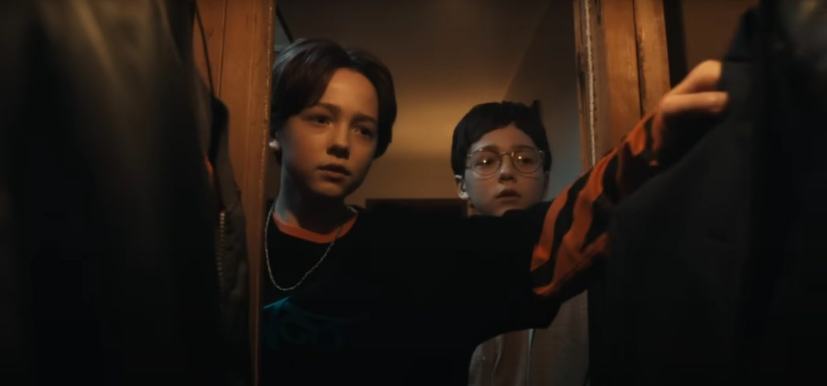
Lois (Tatiana Maslany, who appears in Perkins' fall follow-up Keeper) goes on to raise twin sons Bill and Hal on her own. Remarkably, Sweet Tooth's Christian Convery plays both boys--I never would've guessed they weren't played by two different actors. If they kind of get along in King's story, in Perkins' conception, Bill is a bully and Hal is an inarticulate, bespectacled weakling who doesn't know how to stick up for himself. They'll grow into adults, both played by Theo James, who haven't changed in the slightest.
One day the boys find the toy their father had tried to keep from them. It's a mystery as to how it got into their house in the first place, and it will continue to bedevil them no matter where they go or what they do.
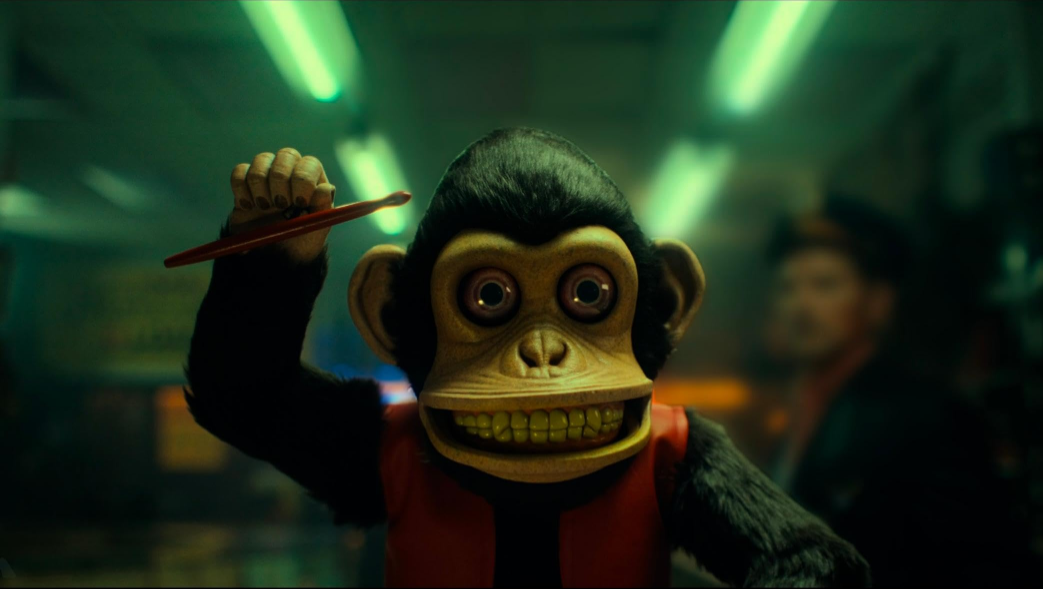
In King's story, the monkey was a broken-down thing with patchy fur, akin to the drumstick-wielding rabbit in Irish filmmaker Damian Mc Carthy's 2020 horror film Caveat, but it's more robust here with a toothy, humanoid grin and penetrating brown eyes. I wouldn't touch it with a 10-foot pole.
Naturally, the boys can't resist turning the key in the back of the creature to see if it still works, but nothing happens–at first. Then, after a few beats of the drum, friends and neighbors start to drop dead. Once they figure out what’s going on, they try to rid themselves of the thing. Hal’s plan, which involves a well, works for 25 years, but the monkey eventually finds its way back to solid ground. By which point, the brothers are fully estranged.
James, a classically-trained British actor, appears to be having a ball as the adult brothers, though he spends most of his time as the hapless Hal, who could make everything better if he just knew how to express himself.
I've always thought James was a fine actor–he received an Emmy nomination for The White Lotus a couple of years ago–but it's a treat to see him getting his hands dirty, a marked contrast to the glossy, James Bond-like Range Rover commercial currently making the televisual rounds.
Hal, a divorced dad who works in a convenience store, has the shitty life he believes he deserves, largely because he's been haunted by this terrible toy that just won't leave him alone. His sober-sided son, Petey (Colin O'Brien), thinks his father doesn't love him, whereas Hal stays away, because he believes he's better off without him, though Petey's soon-to-be-stepdad, Ted (Elijah Wood, also having a ball), is a different kind of awful: a preening narcissist whose wealth comes from self-help books about fatherhood.
Despite their differences, Hal, Bill, and Petey band together in an attempt to defeat the nemesis that has claimed their nearest and dearest, including a swinger with mutton chops played with relish by the director himself (like his father, Perkins started out as an actor before shifting to filmmaking).
This isn't to suggest that the unhappy Shelburn men have put their grievances aside. The Monkey remains a prickly enterprise from start to finish with plenty of gore along the way. By contrast, Perkins drops the climactic sequence from King's story in which Hal, who has a wife and two sons, tries something foolhardy that actually works, and father and son walk off into the sunset, as it were.
Granted, it's a King creation, so there are dark clouds on the horizon. Though Hal bonds with nine-year-old Petey, it doesn't change the fact that he doesn't like 12-year-old Dennis. In Perkins' adaptation, Bill is a bully who grows up to be a mullet-headed loser, but in King's story, he's mostly just unlikeable, the kind of thing no parent wants to admit to themselves.
As with Ted, Perkins adds other characters who weren't in the original story, like Ricky (Rohan Campbell), a leather-jacketed, faded-jeaned, floppy-haired slacker who becomes obsessed with the monkey when he spots it at an estate sale. He looks like the sixth Ramone. If the real band members were smart guys playing at being dumb, this fellow is a cretin born to hop.
I had a great time at The Monkey, better than I did at Longlegs, and I hope other viewers have as much fun. Perkins' approach to "The Monkey's Paw," by way of "The Monkey," never stirred my emotions, like Bob Clark's Vietnam parable Deathdream, a darkly dramatic illustration of fucking around and finding out, but it proves the durability of a story written in another century that has also powered episodes of the Twilight Zone and Night Gallery–Rod Serling was clearly a fan–as well as The X-Files and Tales from the Crypt, both in EC Comics and TV form.
Even horror maestro Jordan Peele (Get Out, Us, Nope) got in on the act by naming his production company Monkeypaw Productions, complete with an image of a shriveled simian appendage, seen in animated form as a severed paw stirring a cup of tea (in Get Out, Catherine Keener's spoon-stirring is as creepy as the rat-a-tat drumming in Caveat and The Monkey). Notably, Monkeypaw produced CBS's 2019 Twilight Zone reboot. Just as notable: Perkins directed alien invasion episode "You Might Also Like" with Gretchen Mol and Greta Lee. It's quite good.
I can't say whether anyone will adapt King's story again, but it's worth a read. Though I haven't seen every film adapted from his stories, Oz Perkins' contribution became an instant favorite, up there withRob Reiner's coming-of-age drama, Stand By Me, an adaptation of 1982 novella The Body. (I was initially impressed by Frank Darabont's1994 The Shawshank Redemption, also from a novella, but have increasingly mixed feelings about it.)
In 1985, King included "The Monkey," which premiered in skin mag Gallery, in his Skeleton Crew collection, which also spawned Darabont's adaptation of The Mist, but W.W. Jacobs' story as a source of inspiration will never go away, kind of like the toy in the 1980 story, always watching and waiting for some intrepid individual to ignore the warning…and…turn…the…key.
Mexican filmmaker Alejandro Gerber Bicecci's third feature is a social realist drama with Godardian flair.
The story centers on subway car driver and mother of two Dalia (award-winning Mexican actress Adriana Paz), who sets out to find her husband, Esteban, when he disappears without a trace, but few people care.
The Mexican Missing Persons system is a pervasive problem due to drug cartels, corrupt police and politicians, and a powerless populace. Plus, it shows no signs of stopping. As Carlos Aguilar wrote in The New York Times in a Feb 8, 2025 piece about the controversies swirling around Emilia Pérez, "Since 2006, over 400,000 people have died and more than 100,000 have disappeared as a result of ongoing drug-related violence across Mexico."
With no one to assist her, Dalia turns detective, which puts her job in jeopardy, and she starts to wonder if her lover (Noé Hernández), a driver hoping to take Esteban's place, or the union opposition had something to do with it, since she and her husband were both outspoken union members.
Hatuey Viveros Lavielle's black and white cinematography is gorgeous and inventive, and since Bicecci shot during the pandemic, streets are largely empty and the occasional face mask appears, bringing to mind the alienation of artful science fiction features, like Jean-Luc Godard's 1965 Alphaville and Sidney Salkow and Ubaldo B. Ragona's 1964 The Last Man on Earth with Vincent Price.
Granted, the streets are emptier at night than during the day, but that only adds to the tension, since a woman walking alone in the dark through some of Mexico City's sketchiest neighborhoods takes her life in her hands.
This is a vital subject and Adriana Paz is fantastic. Dalia is strong, sexy, and caring about her children, who have unique lives of their own--her son, who is openly gay, has recently taken a lover--and other subway car drivers.
At Cannes 2024, Paz shared the best actress award with the cast of Emilia Pérez, which is ironic, because Jacques Audiard's embattled musical, which was shot in France, also deals with the Missing Persons system, and it's by far the inferior effort, even as it's gotten significantly more exposure, more awards consideration, and more attention overall--some of it quite scathing.
For another moving take on the subject, I would recommend Fernanda Valadez's haunting 2021 film Identifying Features, which revolves around a middle-aged mother (an excellent Mercedes Hernández) searching for her migrant worker son. Little wonder Mexican filmmakers are making the least clichéd, hardest-hitting, most personal films about this ongoing crisis.
Dead Man's Switch has been making the film festival rounds, but isn't currently available on video or streaming in the US. As Bicecci told Director's Notes, "Mexico produces around 200 features a year and a lot of colleagues can shoot their films; however, independent author driven social realist films are not exactly the easiest ones to fund, and certainly are the most difficult to distribute." I'll update this post if that changes. Images from Director's Notes (Adriana Paz), Eventival (Paz and Noé Hernández), and Mubi (Paz).
Deathdream was Bob Clark's second horror film and third film altogether.
His first, She-Man: A Story of Fixation, a 1966 micro-budget social problem picture about a trans woman attempting to live an authentic life, often gets left out of his filmography, because he found it embarrassing–it's currently available to stream on Mubi–and doesn't fit neatly into his career, even as that nearly 40-year career was characterized by some pretty big swings.
The now-offensively titled film–though sympathetic in execution–did nothing for his career, but Clark was undeterred. On the strength of his filmography up to 1983's A Christmas Story, after which things got dicey as he succumbed to Hollywooditis, he proved himself a born director.
Clark had the juice and he knew it. Florida had produced other horror and horror-adjacent filmmakers who filmed on location and never broke into the mainstream, like exploitation filmmaker William Grefé (Impulse), but Clark's films got bigger and bigger until the state could no longer contain him. He was living in Southern California at the time of his death at 67 in 2007.
On the basis of his filmography, Clark lived a rich life, and left one hell of a legacy behind. He had a bigger budget, $250,000, for Deathdream than he did for 1972's Children Shouldn't Play with Dead Things, $50,000, but it was still low enough that he relied on location shooting rather than sets (though based in Fort Lauderdale, he filmed in the more picture-perfect town of Brooksville). Nonetheless, there were key differences between the two, though I'll start with the title and the plot.
On screen, the film is titled Dead of Night, and throughout his 2004 commentary track on the 2024 Blue Underground Blu-ray, Clark refers to it by that title. It's an apt one, but a 1945 British horror anthology had already claimed it, so the distributor changed it for marketing purposes.
At various points, Deathdream was also known as Death Walk and Andy Comes Home. That sort of thing plagued many of the 1970s horror films I've covered of late, like 1973's Messiah of Evil and Hollywood 90028.
The film begins in earnest with an unseen soldier hitching a ride with a trucker, followed by an Army officer informing the Brooks family that their son and brother, Andy (the remarkable Richard Backus), was killed in action. In the prologue, Andy died–or appeared to die–so it's a mystery as to how he got to Florida so quickly, and why the Army reported him dead, though it's possible they misidentified the corpse. Stranger things have been known to happen, and that ambiguity will fuel the rest of the film.
That night, Christine (Lynn Carlin, Oscar nominee for John Cassavetes' Faces) and her daughter, Cathy (Anya Ormsby, then-wife of writer and makeup artist Alan Ormsby), pray for Andy's return. Their prayers merge with Carl Zittrer's minimalist music to create one of the eeriest scores I've ever heard as the voices sound more ghostly than corporeal. Feverishly, they whisper, "Come back, Andy…come back, Andy…come back, Andy…." At first it isn't even clear who's speaking, which adds to the eeriness.
For much of the score, Zittrer uses staccato bursts of violin that sound more like spiders skittering up a wall than the sustained, high-pitched sawing of Bernard Herrmann's Psycho score. Zittrer uses these bursts of violin to amp things up, just as he uses violin to express sadness and nostalgia for a different Andy, before the war, when everything was as it should be. As the film heats up, Zittrer segues from violins to what sounds like the thicker, metallic strings of a piano. It's even more unsettling.
A few hours later, they hear a noise, and head to the front door. The family dog Butch, too small to serve as a proper guard dog, is agitated. Dogs know. Either someone tried to break into their house–or they succeeded. It's too dark to see, and at first the family members can't hear a thing.
Then they spot Andy in his uniform standing in the shadows. If you don't jump out of your seat at the sight, you might not have a pulse. He's fully intact, but presumably shell-shocked, since he doesn't speak and barely reacts. Nonetheless, everybody hugs before returning to their respective beds.
It's the first sign that the family doesn't see what they don't want to see. Something is wrong with Andy, and these people aren't stupid, but they're too grateful to accept the truth. God has answered their prayers.
Intentionally or otherwise, Deathdream isn't just an antiwar film, but a film that views Christianity with a critical eye. It isn't the same thing as taking an anti-Christian stance, but praying for someone to return after a reliable authority has informed you that they died is a pretty weird--downright delusional--thing to do. (I have no issue with prayer per se, but there's a difference between praying for something that could happen in the real world and praying for something that could only happen in a dream.)
Granted, the Army could have made a mistake, but in the grand scheme of things, that kind of thing didn't happen often, and mother and daughter never suggest misidentification as a possibility; they just start praying.
In 2010, according to a 2015 report about a misidentified soldier by Colorado NBC affiliate KUSA, "Officials at the Pentagon discovered [at Arlington National Cemetery] more than 200 graves were improperly marked or the remains of people buried in wrong graves." Stranger things indeed.
Andy's return confirms their faith, though Charles (John Marley, Oscar nominee for Love Story) is more skeptical. Even if you haven't watched the film yet, you can guess where all of this is going, and it's to Clark's credit that this 51-year-old film kept me riveted, because nothing plays out exactly as I would have predicted. Plus, I hadn't heard much about it beforehand.
If you've read this far, and you haven't seen Deathdream yet, you should probably stop reading, secure a copy, and come back afterward, though I don't intend to reveal all of its secrets.
If Andy was simply shell-shocked–not that post-traumatic stress disorder is a simple thing–or zonked out on opioids, which wasn't unusual among enlisted men during the Vietnam War, Deathdream might have been another social problem picture rather than a horror film. Instead, Ormsby's screenplay, written in a mere two weeks, suggests all of these things as possibilities with a refreshingly minor amount of exposition.
It's no surprise to find that Ormsby looked to W.W. Jacobs' 1902 short story "The Monkey's Paw" for inspiration. According to the fakir in the story-within-a-story, the lesson for those who use the shriveled talisman to make a wish is that "fate rules people's lives and those who try to change it will be sorry." Like Christine, the mother in "The Monkey's Paw" is just as addled by grief when she wishes for the son who died in an industrial accident 10 days ago to return to life, though there's no prayer involved.
Ormsby, who studied drama at the University of Florida with Clark, also took inspiration from Irwin Shaw's 1936 antiwar play Bury the Dead and Bertolt Brecht's 1927 "Legende vom toten Soldaten," aka "Ballad of the Dead Soldier," an antiwar song so horrifying it reads like comedy, i.e. it's satire, as the Kaiser decides he needs more soldiers, and since the dead ones must surely be faking it, he orders the medical commission to dig up the latest, reanimate the corpse with brandy, and send the putrefying creature back onto the battlefield. Nine years before, Brecht had been drafted into the Germany army, where he served as a medical orderly.
So God answered this family's prayers, but why would the Supreme Being choose the Brooks when thousands of other families had to suffer? No one questions it; they just do what they can to make Andy feel welcome.
Ormsby's screenplay, which is as minimalist as Zittrers's score, reveals almost nothing about the pre-war soldier, and nor should it, other than to suggest that Andy was a pleasant young man who liked to go to the drive-in on double dates with his girlfriend, Joanne (Jane Daly), and his sister and her boyfriend, Bob (Michael Mazes). A clean-cut, all-American kid.
Though Clark was working with renowned actors for the first time, most everyone else had worked on his previous effort, including Alan Ormsby, who wrote the Children screenplay, played the lead, and provided the makeup effects; Anya Ormsby, Jane Daly, and Jeff Gillen, who played members of the doomed theatrical troupe; and Jeff Zittrer, who would continue to collaborate with Clark after his move to Hollywood.
Two years later, Gillen would co-direct the Ed Gein-inspired Deranged with Ormsby, but remains best known for his turn as the surly department store Santa in A Christmas Story. (Though Clark co-produced Deranged, he refused an on-screen credit as he felt the film was too violent.)
Children wears its low budget as a badge of honor, though Clark didn't see it that way. It's equally efficient at 87 minutes (to Deathdream's 88), funnier, and once the zombies emerge, truly terrifying, though the film wouldn't exist without George Romero's 1968 Night of the Living Dead, which Ormsby freely admits. The acting is decidedly not great, and Ormsby, who avoided leading roles in the aftermath, now finds his performance mortifying. (The first time I watched it, his fancy-pants "Alan" irritated the hell out of me; the second time, I found him amusing.)
I reviewed VCI's 50th anniversary edition in 2023, and listened to hours of Ormsby's thoughts about the film and his work in general. He was also involved with Deathdream's special features, and his clear-headed recollections are a joy, not least since he was integral to both films.
In Clark's Deathdream commentary, he laments the corners he had to cut while making his Florida films. Ormsby has complaints, too, but Clark was clearly more pained, though I suspect it made him a better director, because low budgets necessitate creative problem-solving, but if Clark took to Tinseltown like a duck to water, Ormsby did not, stating in his commentary, also from 2004, "I had more fun on all these movies, much more than anything I ever made in Hollywood." He and Clark would reunite for Porky's II: The Next Day in 1983. (On both tracks, they're accompanied by Dave Gregory of Blue Underground and Severin Films.)
Clark didn't make these movies in isolation, so he wasn't the only one doing the solving, but he learned lessons that would surely apply to his more sophisticated studio work, like 1974's sorority slasher Black Christmas, which was filmed in Toronto, and 1979's horror-powered Sherlock Holmes thriller Murder by Decree, which was filmed in London. In both cases, he traded his regional ensemble for internationally-recognized performers, like Olivia Hussey in Christmas and Christopher Plummer in Decree.
Clark was particularly perturbed by Jack McGowan's cinematography for Children and Deathdream, and as soon as he was able to hire someone more experienced, like British-Canadian DP Reginald H. Morris, he leapt at the chance, and his next two films look fantastic--they would work together for the next 16 years--but if McGowan, who passed away in 1977, failed to live up to his expectations, his work serves the material just fine.
McGowan might not have been the right guy for Clark's subsequent films, but he's up to the task here, even as the director was hoping for fewer shadows on the walls, though even Clark admits that the spider web-like, banister-cast shadows in the Brooks' stairway look pretty cool.
Overall, Clark wanted something cleaner, but the film's grittiness proves advantageous–and McGowan would get even grittier for the rural Ontario-shot Deranged.
Deathdream was filmed in central Florida, after all, where it can get more than a little hot and humid, and I like that the actors and their environs never look too buffed, polished, and brightly-lit. When the sun shines, the characters sweat; not a lot, but just enough.
As for Andy’s return, it precedes news about a brutally-slain trucker. The police have no rhyme, no reason–and no leads. The trucker was well liked, particularly by his friends at the diner where he stopped to pick up two coffees-to-go for him and his unseen soldier passenger. It's no spoiler to say that it was probably Andy, and when Charles hears the news, an expression plays across his face that's as plain as day: he's pretty sure his son did it, doesn't want to believe it, and tries to push the thought aside.
Knowing that John Marley and Lynn Carlin had played a married couple in Faces, Cassavetes' fourth feature, I decided to catch up with it, assuming that the film had served as a dress rehearsal for their matrimonial dynamic here. Not hardly. In fact, I'm rather amazed that Clark hired the two of them, not because they aren't good--they're great--but because the roles are so different. They spend most of Cassavetes' tense drama apart, so it's mostly Marley acting opposite a glamorous Gena Rowlands, Cassavetes' partner in life and work, who plays his call girl mistress, and Carlin acting opposite a jumped-up Seymour Cassel, who plays a playboy she and her sex-starved, middle-aged lady friends meet at a nightclub.
In his commentary, Ormsby admits that Marley, a slight man with a heavily-lined face, wasn't what he had in mind when he wrote the screenplay.
He had envisioned a high school football coach-type. Someone younger, bigger, and stronger, but Clark's risk pays off, because the 65-year-old Marley--who had already survived The Godfather's ghastly horse-head ordeal--does a lot of acting with his expressive face, just as he did in the Cassavetes' film, moving masterfully from suspicion to fear to heartbreak.
Backus, an Emmy-winning actor and writer, gets as much use out of his face, and he gives one of the best movie-monster performances I've ever seen. Critically, he never overplays his hand, and it's consistently unnerving. As in Black Christmas, Clark gets maximum mileage out of an old fashioned rocking chair, of all things, and there are few sights more chilling than Andy rocking in a dark room with the hint of a smile on his face. It's hard to blame Charles when he recoils from the spectacle.
Though I can't imagine anyone more perfect in the role, Clark originally cast the lesser known Greg Swanson. When he realized Swanson wasn't working, he switched him with Backus, but retained the prologue. It was a kindness to keep him in the film–and a money-saving measure, as well–but it confused me the first time I watched it, because I noticed that postwar Andy looked like a completely different person. The Blue Underground release features an interview with Swanson, in addition to a screen test, and he's not bad, but Clark definitely made the right choice.
At first Andy plays along with the family, hanging out with them at times, but never eating and rarely saying much.
At other times, he disappears for nocturnal misadventures, one particularly nerve-jangling episode involving As the World Turns mainstay Henderson Forsythe as the family doctor.
When Andy smiles, it's either an enigmatic expression that could mean something–or nothing–or a mirthless embodiment of malevolence. Much like Willard Huyk and Gloria Katz's screenplay for Messiah of Evil with its red-eyed, white-faced townsfolk, Ormsby never explains what's going on, and it's for the best. This freed him and Clark from adhering to the rigid vampire rules established by Bram Stoker in his definitive 1897 text.
Unlike Dracula, Andy doesn't find sunlight disempowering (though he prefers the dark), he doesn't have canine incisors, and he doesn't munch on necks--like Romero's Martin, he prefers knives and needles--but he requires a certain substance to keep going, and you can probably guess exactly what it is. When deprived, he starts to desiccate, slowly at first before picking up speed as he becomes increasingly dehydrated.
Though Ormsby never indicates what might be going through Andy's head, he appears to be focused on survival above all else. He's a shark; always looking forward, never back. If his immediate family isn't in imminent danger, everyone else–including Charles's beloved Butch–is fair game.
At this point, I should mention the eager young man Ormsby hired to assist with the makeup effects. Though neither writer nor director had served in Vietnam, they had a former combat photographer on set who had witnessed more horrific sights than either could possibly imagine. While some veterans might have moved towards the light, Tom Savini embraced the darkness, and it would come to define his entire career as horror makeup artist, stunt performer, actor, director, author, and for some, an icon of the form.
The 26-year-old Savini was, according to Ormsby, a nerdy guy who would completely transform his appearance in the years to come by working out, growing that famed goatee, and, supposedly, going under the knife.
Like the screenwriter, who experimented with horror-movie makeup in his youth, Savini was obsessed from an early age, and he had arranged to work on Night of the Living Dead before getting drafted, so Deathdream marked the start of his career, and it led to everything that came next, since he would go on to work with Ormsby on Deranged before reuniting with Romero in 1978 for Martin--which has a lot in common with Deathdream--and Dawn of the Dead. The rest is history, but I wouldn't have predicted that an assistant would go on to become the most famous person involved with the film, though Ormsby remembers soap star Forsythe as the participant who had the town of Brooksville most excited.
In his commentary, Ormsby regrets that he and Savini got too carried away with the makeup effects towards the end, and he's not wrong, but the subtle changes when Andy first starts to decay work wonderfully well as his skin loses elasticity and threadlike lines appear across his youthful face.
Later, Andy's eyes change from hazel to blueish-white–the result of painful scleral contact lenses that could only be worn for brief periods of time–and the entire outer layer of his body begins to deteriorate and, um, ooze, so Andy starts to wear a zip-up turtleneck, dark glasses, and giallo-esque black leather gloves, which adds unintentional humor to the scenario, because he now looks like a member of the Velvet Underground.
If Deathdream, for me, comes down to the relationship between father and son, because Backus and Marley give the most searing performances, Clark reserves the climactic sequence for mother and son.
I won't give too much away, other than to say that Charles believes Andy is too much of a mama's boy, and that isn't just his 1950s-era machismo talking. When he expresses concern about their daughter's safety while she's at the drive-in with her increasingly hostile brother, Christine gives the game away: "I don't care about Catherine!," she wails. Beyond her faith, it helps to explain why she's been tolerant--and even somewhat accepting--of his disturbing behavior for longer than her more egalitarian husband.
Even by the end, though, Andy still has a trace of humanity left. He knows what he needs to do, and as much as his mother doesn't want to let him go, she's there for him as he makes his second exit, and her final words, and the way Carlin delivers them, say as much about her family as they do about the thousands of other families during the Vietnam War who were also mourning their sons. It's the one time she admits that the Brooks were blessed–chosen, as it were–to get exactly what they asked for.
Alan Ormsby's moving finale, as beautifully directed by Bob Clark, echoes what Bertolt Brecht wrote about that reanimated soldier so very long ago.
But the moon won't stay there the whole day through
For the sun won't pause for breath
The solder did what he'd been taught to do:
He died a hero's death.
Deathdream is out now on a 4K UHD + Blu-ray via Blue Underground.
Images from the IMDb (Richard Backus and Greg Swanson), Rotten Tomatoes (Bob Clark), Cool Ass Cinema (title card and Backus with John Marley and Lynn Carlin), Amazon ("Monkey's Paw" cover), Abe Books (Bury the Dead cover), Dangerous Minds (Olivia Hussey in Black Christmas), The Criterion Collection (Carlin and Marley in Faces), Tubi (Marley), Boston Hassle (Backus), and Red Bubble (Deathdream poster).
(Satoru Kobayashi and Shao Bao-Hui, 1968, Taiwan, 90 minutes)
Could've tripped out easy
A-but I've a-changed my ways
--Donovan, "Sunshine Superman" (1966)
You can tell you're in for a good time when a film--black and white in this case--opens with several satin jumpsuit-clad characters with metallic papier maché heads all converging on a bug-eyed salary man, leaving him flat on his back, without his briefcase, and with blood dripping from his mouth.
It reminded me of the vampiric kills in Messiah of Evil or Interview with the Vampire, except more loopy than disturbing. If it wasn't a good time for the salary man, who would not survive the attack, it definitely was for me.
Turns out the oddly-dressed miscreants are members of the Cosmos Gang. They look like aliens with their oversized heads and long spindly fingers, though maybe they just have bizarre taste in gloves. I'm not sure it matters one way or the other. Dragon Superman, aka Dragon Ghost Flying Knight,which premiered in Seattle in a new 2K restoration last spring, is the kind of crazy, mixed-up film where you have to just go with the flow.
Two gang members are next seen swiping jewels from a reception hosted by supermarket magnate Mr. Liu (Yang Weixi) and attended by San Lin-Jun (Kuei Chih-Pang), a straight-laced newspaper reporter, and Mr. Mischief (Lai Te-Nan), a Jerry Lewis-like photographer. The gangsters give the authorities the slip when they clamber into a helicopter and fly away. They'll later return to steal Mr. Liu's golden lamp stand, a treasure--as he keeps repeating--from the Inca Empire.
If the authorities are no match for the gang, Hong Kong superhero Dragon Superman just might have what it takes to bring them to justice, though he doesn't look especially formidable in his silky white scarf and bat-ear mask.
The Batman TV series with Adam West premiered on ABC in 1966, just two years earlier, though I'm not certain whether director/cowriter Satoru Kobayashi, codirector Shao Bao-Hui, and cowriterChen Hsiao-Tao were familiar with it, not least since the film is an adaptation of Maboroshi Tantei: Chiteijin Shûrai, a manga adaptation from 1960. But I'd imagine they were.
Other characters include visually-impaired singer Li-fen (Wu Min), her femme fatal-ish sister Li-sa (opera star Liu Ching), Mr. Liu's secretary, and the sisters' brother, a handsome man whose primary trait is his handsomeness (I regret that I was unable to track down his name).
Beyond their thieving, murdering, and crimes against fashion, the gang members proceed to abduct Li-fen and Li-sa, Mr. Liu's granddaughter, and even Mr. Liu himself. They also terrorize San Lin's family. Along the way, Kobayashi reveals that the reporter is actually Dragon Superman, which comes as no surprise whatsoever, or I would've kept it to myself.
The film appears to have been designed to capitalize on several trends popular on the American B-movie/drive-in/grindhouse circuit, but given a Taiwanese twist by a Japanese filmmaker (the film takes place in Hong Kong due to Taiwan's then-current censorship laws). It's sci-fi, film noir, and thriller, all set to composer Tseng Chung-Ying's percussive score.
Though it's the first of his films that I've seen, Kobayashi has 385 directorial credits at the IMDb in a career that spanned 43 years. As appealingly rough around the edges as it may be, Dragon Superman was his 39th feature.
The budget was surely low, but the film looks good enough, though the Foley work is out of control. For some reason, Kobayashi decided to amplify every footstep, so that the soundtrack is filled with non-stop clicks and clacks. For my money, it adds to the charm, though your mileage may vary.
Considering that the narrative ends on a cliffhanger, I hope the delightfully-titled sequels, Moonlight Superman, and Skyfly Superman, which were also released in 1968 and restored in 2023, make their way to Seattle, too. In case you're curious, these are the summaries I found at the Taiwan Film and Audiovisual Institute:
Moonlight Superman
To obtain the Golden Light Statue, the Cosmic Gang takes the owner's family hostage. The "Detective Boys" witness a crime and are kidnapped by the Gang. San Lin-Jun hears their cries and suits up to save them.
Skyfly Superman
The thieves take children and women hostage for experiments. Dragon Superman arrives in time to defeat the villains and save them out. However, Yuan-Tai's parents seem to hide some secrets, suggesting a larger conspiracy.
I'm not sure why SIFF 2024 only programmed the first film in the trilogy, but one is better than none. I'll update this post if I hear about any screenings or home-video releases; for now, the films are making their way around the world theatrically. Images from the Taiwan Film and Audiovisual Institute (Kuei Chih-Pang and the poster image), Taiwan Film Institute (Kuei and Lai Te-Nan), and Urania National Film Theatre (Kuei and Lai redux).
Mike Whybark, who set up this site in 2004 as a way to cover the Seattle International Film Festival in an approximation of real time, tagged me on Facebook in his remembrance of David Lynch (some time after I took over, I changed the site name from SIFFBlog to Seattle Film Blog, on the recommendation of Rotten Tomatoes, to avoid any confusion with SIFF).
With his permission, I'm sharing Mike's remembrance here. I've posted a few obituaries over the years--Sidney Poitier, Norman Jewison, etc.--but they've been more formal in nature. Mike's is more personal and specific to his background, and that makes it unique. I would also recommend Irish filmmaker Paul Duane's remembrance, which is just as personal and yet more fair than some of the official ones, which have dismissed certain Lynch films (you may have to sign up to read Paul's piece; it's worth it). We all have our favorites, but I don't believe an official obit is the best place to list one's least favorites.
MIKE REMEMBERS DAVID (WHILE ON THE ROAD)
I've been busy with this trip to the wilds of the Eastern Coast, to one of the vanguard states of the end of American democracy, and have neglected to post concerning my sense of grief and loss at the passing of David Lynch, a film director whose work I adore.
David's death uncannily overlaps the catastrophic wildfires in Los Angeles, a city I actively avoided until I met my wife Vivian and which I now know pretty well, although my Angeleno pals will surely dispute me. I love the town, as much as I love Mexico City, NYC, London, Tokyo, and Seattle.
Right: David and daughter Jennifer Lynch
Some Bloomington people will know that David's daughter is a distaff townie due to her time at Interlochen in Michigan and her having developed friendships with some of our artsy crew that also spent time at the school, and I have been thinking of her and her loss quite a bit this week.
I absolutely adore and am baffled by Lynch's filmography. The two films that had the greatest cultural impact upon release that I saw in theater at initial distribution are Lynch's Blue Velvet and Tarantino's Pulp Fiction. I vividly remember exiting the theater from each screening and standing amid a stunned, gabbling crowd. Blue Velvet preceded Pulp Fiction, and I have always harbored the suspicion that Tarantino also stood amid a gabbling crowd of Blue Velvet attendees and thought to himself, I am gonna top this.
Ultimately, I think Lynch is a greater, more profound artist than Tarantino.
Film is a demanding artistic discipline that inherently resists off-the-cuff creativity at scale and exerts profound pressures on the artists engaged in the work, from director and scriptwriter to grips and PAs, to maximize transparency, clarity, and narrative flow. Lynch's entire career shows us how to resist that and to privilege other objectives in the act of creation, in the act of consumption, in our day-to-day lives.
If you have ever spent any time with me in person, you know that's what I love the most, the difficult, the obstreperous, the nonsensical. David, somehow, managed to build a life creating material that stems from a similar place. We are the richer for the experience of his work, and the poorer for his loss.
Similarly, we are all the poorer for the fiery catastrophe moving through parts of the vast urban landscape of Los Angeles, one of Lynch’s primary muses. Fire has indeed walked with us. It's still another beautiful day in LA. I mean I assert that as a theoretical proposition from the East Coast, but I feel I am on solid ground in my expression. See you at the Big Boy.
Images from Studio Idan (David Lynch in his beloved Los Angeles), HELLO! Magazine ("Jennifer Chambers Lynch and her father David attend the premiere of Surveillance in 2019"), and American Cinematheque (Kyle MacLachlan and Isabella Rossellini in Blue Velvet).
Coverage of the Seattle International Film Festival and year-round art house programming in the Pacific Northwest.
Kathy Fennessy is former president of Seattle Film Critics Society, a Northwest Film Forum board member, and a Tomatometer-approved critic. She writes or has written for Amazon, Minneapolis's City Pages, Resonance, Rock and Roll Globe, Seattle Sound, and The Stranger.