This Is Congo filmmaker Daniel McCabe begins his patient, observant documentary, an extension of Michele Sibiloni's 2021 photo book Nsenene, with magnified images of grasshoppers, or "bush crickets," being born. They start out as glossy oblong tubes before poking out their heads and unfolding their impossibly slender limbs. There's nothing quite like them. Many bugs give me the heebie jeebies, but grasshoppers aren't half as creepy as spiders.
From the birth scene, McCabe shifts to remote, hilly Bundibugyo in Kampala where workers are toiling away on some unidentified project. Twenty minutes into the film the foreman reveals that he'll be using the equipment his men have been moving and setting up, including a rickety generator, to capture grasshoppers. McCabe spent three years capturing the capture.
It isn't just difficult work, it's dangerous, disruptive, and time-sensitive, since grasshopper mating season only lasts for a month or two. The equipment, which involves incandescent lights with the glass bulbs removed--treated so that they emanate an eerie green glow at night--can destroy crops and cause permanent skin and vision damage, but it pays more than most other jobs in the area, even those in the healthcare field. In other words, the men stand to make more in three months than the pharmacists who dole out the pills and ointments needed to treat their ailments.
During the film, trappers quarrel with land owners who would prefer that they just go away, but instead they negotiate for the highest fees they can possibly get. It isn't greed; the capture process is so invasive, it can ruin crops for generations, especially when it comes to maize, a Ugandan staple. The trappers also quarrel among themselves. "You look like a cow's anus!," one young man quips to another while struggling with the heavy generator.
Once the grasshoppers start to arrive, they come in Coke-bottle-green droves, flapping and fluttering against the cassava-coated corrugated iron chutes designed to trap them. It's as much a percussive phenomenon as a visual one. Once caught, trappers bring them to town to sell the bushels of bugs on the streets or at market stalls. I couldn't say what happens to them after that, other than they're intended for human consumption. For what it's worth, my dad ate a fried grasshopper while stationed in Asia in the early-1960s, while in the Air Force--probably during a stop in Thailand--and was not impressed. He wasn't grossed-out, necessarily, but to paraphrase David Foster Wallace, it was "a supposedly fun thing he would never do again."
I haven't mentioned any of the workers by name, because McCabe doesn't identify them, putting them on the same plane as the grasshoppers, which may have been the point. Vivid cinematography from McCabe, Michael McCabe, and Michele Sibiloni--including close-up imagery of beetles, caterpillars, and the 35 other creatures listed in the credits--combined with Candyman composer Robert Aiki Aubrey Lowe's alternatively playful and meditative electronic score add to the appeal of a documentary that revolves as much around human versus human as human versus insect.
Grasshopper Republic plays Mon, May 13, at 12:30pm at SIFF Downtown and on Wed, May 15, at 9:15pm at Pacific Place. Click here for more information. Images from Cleveland International Film Festival and Doc NYC.
THE PRIMEVALS (David Allen, USA, 2023, 90 minutes)
Because David Allen's The Primevals wasn't completed until last year--24 years after his death--it's classified as a new film. It definitely does not look like one. Though principal photography dates back to 1994, the animation work began in 1978, and the stop-motion effects are no more sophisticated than those of the Rankin/Bass productions of yore (Allen is best known for his effects work on Joe Dante's The Howling and Ron Howard's Willow). If anything, the yeti recalls the great ape in Merian C. Cooper's original 1933 King Kong--the same film that encouraged Allen to go into filmmaking.
After scientists acquire the body of the yeti, who was buried in an avalanche, they set out, along with an impetuous Sherpa and macho tracker Rondo Montana, to find out why this specimen lived such a violent life.
Except for Juliet Mills, who brings her well-trained professionalism to the role of the senior scientist, the acting is middling at best, and things never get as wild and wiggy as in 1981's similarly-constructed Clash of the Titans, which featured the final work of animation legend Ray Harryhausen. That said, the lizard-like aliens are fun in a demented Sid and Marty Krofft kind of way.
Though it's always nice to see that stop-motion hasn't been completely abandoned as an animation technique, and though it's heartening that Allen's associates and crowd-funding fans saw the film to completion, The Primevals plays more like a basic cable movie than a full-fledged motion picture. On the plus side, it's suitable for the whole adventure-loving family, and it's sure to provide more entertainment value in a grand old theater during a film festival than on a computer screen in my apartment.
The Primevals plays the Egyptian on Fri, May 10, at 11:59pm and on Tues, May 14, at 9:30pm. Click here for more information.
TONY, SHELLY, AND THE MAGIC LIGHT Tonda, Slávka a Kouzelné Světl (Filip Pošivač, Czech-Slovak-Hungarian, 2023, 82 minutes)
I'm the man with the light bulb head I turn myself on in the dark I'm the man with the light bulb head I turn myself on for a lark. --Robyn Hitchcock (1985)
Unlike The Primevals, this Eastern European production dispenses with pesky humans--who needs 'em--for an all-stop-motion affair. The story center on 11-year-old Tony, who frequently wears a mask, because he doesn't look like other kids. His parents have also attached him to a tether, much like a dog on a leash, so he isn't able to wander far from their apartment.
When the outspoken, bespectacled Shelly and her gloomy mother Sylvia, a retired actress, move in to their building, Tony finds himself enchanted by Shelly's magic flashlight, which brings her fantastical imaginings--from jungles to dinosaurs--to colorful life. The thing is: only he can see them.
After bratty neighbor Ernestine inadvertently unmasks Tony, Shelly finds herself equally enchanted by his glowing head. In fact, he's thoroughly incandescent. When he rescues her pet bird Fanny, she dubs him "Glowing Super-Tony." Though it's great to have a friend--possibly his very first--Tony remains firmly attached to the tether, and even when he's around, his overprotective parents spend more time doting on their non-glowing toddler twins. Tony just wants to be free, like Ernestine, Shelly and Fanny.
In addition to their parents, the duo's other antagonists include Ernestine's purple-clad mother, Miss Tubby, and the building's evil spirit, a big, black, caterpillar-like creature made up of tiny fuzzballs. When the neighbors argue, a common occurrence, the fuzzballs materialize and multiply like Tribbles before forming one all-consuming blob.
Only the aging and creaky caretaker is able to keep it under control.
Though Tony, Shelly, and the Magic Light includes plenty of unique details, the ending may remind older viewers of Harry Nilsson's animated film The Point!--this is not a bad thing--and though extremely kid-friendly, it features English subtitles rather than dubbing, so parents should be advised. Fortunately, the animation is intricate and imaginative enough to keep most pre-readers engaged, and even if it isn't targeted at my age group, I find it hard to resist sympathetic stories about neglected and misunderstood misfits who find other creative square pegs to ease their loneliness.
Tony, Shelly, and the Magic Light plays the Egyptian on Fri, May 10, at 4:15pm, and at SIFF Downtown on Sun, May 19, at 1pm. Click here for more information. Images from Fantasia 2023 (Juliet Mills, Richard Joseph Paul, and Leon Russum), YouTube (Tony and Shelly), and Nutprodukcia (Miss Tubby and Ernestine, Sylvia, Tony's mother, and the caretaker).
Luther Vandross was a quadruple threat: singer, songwriter, producer, and arranger. He was also a man who never found the love he spent his life singing about, territory director Dawn Porter (John Lewis: Good Trouble, The Lady Bird Diaries) handles with delicacy and restraint.
She begins her profile in black and white as Vandross rehearses for an engagement at London's Royal Albert Hall. Everyone, including the star, is dressed casually, but they're giving it their all. She then segues to color footage of the 1994 show with everyone dressed to the sequin-bedecked nines in front of a crowd losing their shit to his version of Philly duo McFadden & Whitehead's 1979 disco hit "Ain't No Stoppin' Us Now."
She then backtracks to TV interviews in which Vandross talks about his Bronx childhood. His family was hardly rich, but he felt he had everything he needed, and he had something to aspire to: Motown. Not so much the label itself, but the Black excellence groups like the Supremes represented: talent, polish, popularity. He felt the same way about Dionne Warwick and Aretha Franklin. His interest in male singers appears to have been minimal.
Since Vandross passed away in 2005, Porter turns to friends and associates for recollections about the artist, like Carlos Alomar and Chic associate Fonzi Thornton who played in his first group, the Shades of Jade. "He was a boss from the beginning," Thornton remembers, sharing a story about how Vandross appealed to his cash-strapped mother to buy her son green patent leather shoes in order to live up to their unusual moniker. What mother could resist such a polite and persuasive young man? Certainly not his. And not Alomar's Puerto Rican mother either--even though she didn't speak any English.
En route to solo success, Vandross segued to the vocal group Listen My Brother, which often performed at the Apollo Theater (Roger Ross Williams's Apollo, SIFF '19, is an excellent primer on the legendary venue). The group included his best friends Thornton, Alomar, and Robyn Clark, who also appears in the documentary. Vandross, as was often the case, was in the right place at the right time, since Jim Henson heard about the Black empowerment-oriented group and hired them for a new show set in a Harlem-inspired neighborhood: PBS's groundbreaking Sesame Street.
To Alomar, Vandross had a voice made for success, but believes that his dark complexion and solid build went against the qualities prized in Black singers of the late-1960s. Beyond his talent, he was a bright young man, and he went off to college at Western Michigan University while his friends kept singing, but it wasn't for him, and he dropped out after the first year.
From there, he would again end up in the right place at the right time: Philadelphia during the days of the fabled Philly Sound.
When David Bowie decided to make a decisive break from London glam, he headed to Philadelphia for 1975's Young Americans, his self-described "plastic soul" album. Exclaimed Bowie, "I love this guy!," remembers backup singer Ava Cherry. Bowie, who appears in archival footage, was at the height of his androgyny with sculpted hair, bleached brows, and eyeliner. That same year, he claimed he was bisexual. Twenty years later, he would describe himself as a "closet heterosexual." Vandross, by comparison, looked like the straight one.
All of this would have been good enough for any young singer, but Vandross also revealed talents for songwriting and arranging, and he would receive credit for both on the album--it says a lot about Bowie that he shared writing credit with him on "Fascination." Not all superstars are as generous.
With an introduction from Bowie, Vandross moved on to Bette Midler. Once again, he was part of a gay-coded milieu (Midler started out singing in bathhouses). Porter's speakers don't mention any of this, but you can see her building up to it. Not least because there's no mention of his relationships; just his platonic friendships with both men and women.
If he wasn't yet a star in his own right, Vandross became an in-demand session singer on national commercial jingles and with top-selling soul, funk, and disco acts, like Sister Sledge, Chic, and Roberta Flack. As Nile Rodgers points out, Vandross appears on every song of Chic's first two records, including 1978's immortal "Le Freak." Just as Bowie tapped Vandross's varied skills, Flack did the same. As much as she valued his contributions to her stage show, she believed he should have a spotlight of his own, and actively pushed him in that direction.
With that boost, Vandross cut "Never Too Much," the 1981 single and title track that finally made him a foreground star. Platinum-selling albums, talk show appearances--14 with Oprah, an ardent admirer--and production work for Warwick and Franklin, the still-vital icons of his youth, would follow. This is also around the time he started wearing his signature eyeliner, a detail that goes unmentioned, even as it added to his physical allure.
Unlike some peers, he also had a sense of humor. When Eddie Murphy marveled in his 1987 stand-up special Raw that "this Kentucky Fried Chicken-eating motherfucker" could make the ladies swoon, Vandross brought out a giant KFC bucket for a show at which he knew Murphy was in attendance and even sang a few lines of the chicken-slinger's latest jingle.
Nonetheless, his weight fluctuated throughout his life. Vandross explained to one talk show host, "I was an emotional eater." As the title of the documentary attests, he was an all or nothing kind of guy; he was either eating or dieting. There was no healthy middle ground. When things weren't going well, he turned to food to cope, but if he kept some aspects of his life private, he was open about his struggles with his weight.
He was also open about his desire to cross over to a wider audience, but felt that his label was holding him back. Friend and cowriter Richard Marx backs him up, claiming that Epic spent more money promoting white artists.
It may seem like ego--the desire to be embraced by all listeners--but I believe it was also about longevity, because if Vandross was riding high in the 1980s, by the late-1990s, his record sales were slumping while hip-hop was dominating the airwaves. It's worth noting that Sony produced this documentary, and Jon Platt, CEO/Chairman of Sony Music Publishing, is among the speakers, which may be why Porter doesn't mention that Vandross sued to be released from his Epic contract. As his attorney Don Engel told The Los Angeles Times in 1992, "He feels that Sony has pigeonholed him and has not done all it could to expand his audience."
Fortunately, his hit-making days were reignited when he signed to Clive Davis's J Records, though the documentary omits mention of the album, I Know, Virgin released after he fulfilled his Epic contract.
Porter only turns to Vandross's personal life after establishing the contours of his career. For Jamie Foxx, who co-produced the film, his love songs were a way to win ladies' hearts, but what about Vandross's heart?
He would tell friends that he hadn't found love, but that he hadn't given up hope.
No one--except Patti LaBelle in a talk show appearance that upset his friends--says he was gay. The consensus was that he would rather be alone than to act on such feelings. It was the one aspect of his life he kept to himself such that he never even denied the claim. He would simply refuse to dignify such speculation with a response--other than to sue British magazine Blues and Soul when it falsely claimed that his 1985 weight loss was due to AIDS.
Though that sort of secrecy and protectiveness tends to suggest that a public figure is gay, that isn't always the case. Like Vandross, Tim Curry, who turned 78 this year, never married, had kids, or ever said whether he is gay or straight. Though he emerged from a subculture--London's theatrical scene in the early-1970s--when androgyny and/or the impression of bisexuality was practically de rigueur, he has always kept his private life private.
From my research, while working on a paper about Curry, I came to the conclusion that he's probably straight, but I couldn't say for sure, not least because he didn't drop clues the way, say, Freddie Mercury did. What I can say is that neither man ever found the love of his life. Curry claims that he was in love once, but it didn't last. In the documentary, Vandross says he fell in love a few times, but that his affection was never returned.
I'm not certain when Vandross was diagnosed with diabetes, but it represented an increasing threat. If he was open about his weight in the 1980s, by the 1990s, he was tired of talking about it, even as reporters continued to ask. It wasn't just about vanity; his life was on the line. To Marx, the obsession with his weight obscured his artistry. Starting in 2003, Vandross would experience some of his biggest professional successes--and some of his worst health setbacks. He was only 54 when he died.
Though I had hoped to learn more about his personal life from Never Too Much, Dawn Porter honors his artistry from start to finish. This is also a fully authorized biography, but even if it wasn't, she may still have chosen to respect Vandross's privacy. Nowadays, the choice not to disclose one's sexual orientation isn't as respected or accepted as it once was, and some music fans view figures like Vandross as relics. They're entitled to their opinion, and I love a happy coming-out story as much as anyone, but in the end, a public figure doesn't owe us any detail whatsoever about their private life, not even a man whose voice, songs, productions, and performances set millions of mostly-female hearts aflame.
If he never found the kind of romantic "forever, for always" love he sang about with such passion, it's clear that Luther Vandross had friends he loved dearly who loved him with equal ardor. Not everyone can be so lucky.
Luther: Never Too Much plays the Egyptian on Fri, May 10, at 6:30pm and Pacific Place on Sun, May 19, at 1:30pm. Dawn Porter will be at the May 10 screening. For more information, click here. Images: Indiewire via Sundance Institute and Sony Music Entertainment, RCA via Smooth Radio (Vandross and David Bowie), Ebet Roberts / Getty Images (Roberta Flack and Vandross backstage at Madison Square Garden on Sept 11, 1982), Lisa Fischer's Facebook (Vandross with KFC bucket), Ron Galella/WireImage via TV One (Vandross and Patti LaBelle), and Billboard (Vandross and Richard Marx).
This is a revived version of a 2011 Line Out post (these posts were purged from the internet some time after The Stranger pulled the plug on their music blog).
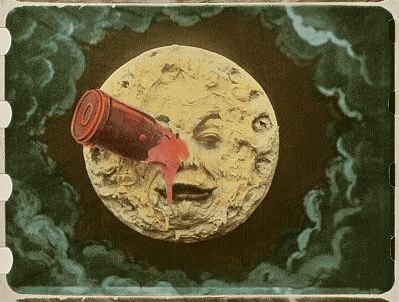
Since I just caught Martin Scorsese's Hugo, which incorporates magician-turned-director Georges Méliès (wonderfully played by Ben Kingsley), news about Air's upcoming record arrived at the perfect time. It's titled Le Voyage dans la Lune after Méliès' most famous film, i.e. A Trip to the Moon. The label sent the press release the day after the movie opened.
In Hugo, Scorsese doesn't just recreate portions of Le Voyage--in 3D, no less--but he also recreates the making of this 1902 landmark.
For a motion picture adapted from a young adult novel (Brian Selznick's 2007 The Invention of Hugo Cabret) and intended for family viewing, Hugo is a more richly rewarding enterprise than I would have expected. If Air's album is even half as good, it should be worth the wait.
While it's been awhile since I've picked up an Air recording, I remain fond of their haunting score for Sofia Coppola's The Virgin Suicides, another period adaptation, so I have a good feeling about Le Voyage dans la Lune.
I should also mention that I'm a big fan of musician/graphic artist/filmmaker Mike Mills (Butter 08, Thumbsucker, Beginners), Air's go-to director. You can sample his work on YouTube or, better yet, in the 10th anniversary edition of Moon Safari, which includes the key videos and a documentary.
Full press release, Hugo trailer, and Méliès' film below. H/t: Steven Fried
Le Voyage dans la Lune is a classic black & white silent film by revered French director Georges Méliès. Released in 1902, this legendary 16-minute film is widely considered one of the most important works in film history, and the very first to use science fiction as its theme, incorporating special effects that were very state-of-the-art at the turn of the 19th century. It was loosely based on two popular novels of the time: Jules Verne's From the Earth to the Moon and H. G. Wells' The First Men in the Moon.
A hand-colored print, the only one known to survive, was rediscovered in 1993 by the Filmoteca de Catalunya. It was in a state of almost total decomposition, and many years of painstaking, manual restoration took place until 2010, when digital technology finally came to the rescue. Following another year at the Technicolor Lab of Los Angeles, it was finally ready to share with the world. Eager to put a contemporary spin on this classic silent film, the producers decided to approach AIR's Nicolas Godin and Jean-Benoit Dunckel, to compose an original modern soundtrack, an enormous honor for French musicians, considering the film's place in the canon of French cinema.
Spurred on by their work on this short movie, AIR decided to develop the project into a full album inspired by the film. Expanding the original musical themes beyond cinematic instrumentals, the album also features the vocal talents and lyrics of Au Revoir Simone and Victoria Legrand (Beach House). The band's lunar fascinations have been evident since the beginning of their career with the release of the seminal 1998 classic Moon Safari. Now in 2012 Nicolas and J.B. have returned to explore the further regions of their very unique musical "space."
A special 3-minute extract of the film will be made available FREE for one week only on iTunes on December 6th. And on that same date, the AIR album pre-order will start including a STRICTLY LIMITED EDITION digital box set featuring the album and the newly colorized, restored film featuring AIR's original score.
Track listing:1. Astronomic Club, 2. Seven Stars (with Victoria Legrand), 3. Retour sur Terre, 4. Parade, 5. Moon Fever, 6. Sonic Armada, 7. Who Am I Now? (with Au Revoir Simone), 8. Décollage, 9. Cosmic Trip, 10. Homme Lune, 11. Lava.
Virgin releases Le Voyage dans la Lune on 2/7/12 in the US and Canada.
As his fourth feature begins, British filmmaker Alex Garland doesn't mess about. There's no prologue, no opening crawl, no exposition dump. The time could be now, or it could be just a few years in the future, because everything looks much the same, except the country is at war. With itself.
In a sense, that's exactly what's happening in 2024 with red and blue state America, except Garland isn't as interested in liberal vs. conservative as in war itself, though the film's primary antagonists, mostly camo-clad white men, have all the markings of insurrectionists. Instead, the director explores what a first-world civil war might look like, sound like, and especially feel like in the 21st century. And how it might affect a combat photographer.
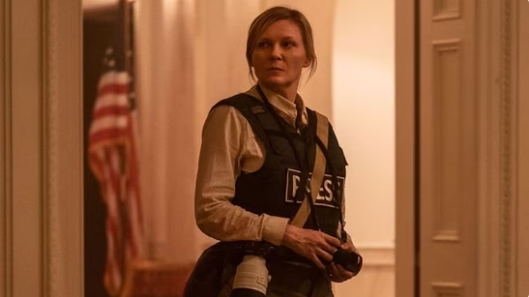
Garland introduces Reuters photojournalists Lee (an effectively hard-bitten Kirsten Dunst) and Joel (Wagner Moura of Elite Squad and Netflix's Narcos) by showing them in action, crouching fast and low, hands gripped tightly around their cameras, getting as close to a New York riot as possible, and then slipping away as quickly as they can. In the melee, Lee spots the petite Jessie (Cailee Spaeny from Garland's FX series Devs), an amateur photographer, who gets walloped by a cop. Like a mother hen, she whisks her away to safety. Not only is Jessie okay, but she recognizes the photographer. In fact, she's an ardent admirer who aspires to emulate her.
After chatting for a bit, they go their separate ways, with Lee giving the distinct impression she thinks this kid is a bit of an idiot. She's not wrong--though 23, Jessie looks and acts much younger. If Lee seems condescending or judgmental, it's more that she wants to dispel Jessie's naïve and idealistic views of photojournalism, but without completely scaring her away.
That night, she runs into Jessie at the hotel where she has returned to connect with Joel and Sammy (the always welcome Stephen McKinley Henderson from Devs and Dune), an older New York Times reporter.
Jessie swears--not all that convincingly--she hasn't been stalking her, but Lee has her doubts. The younger woman explains that the hotel serves as a known meeting place for photojournalists, and she wants to get in on the action. To Lee, she's starting to become as annoying as a relentless gnat.
Though she and Joel make a few japes about Sammy's age, he can take it, and he's just as quick to make the occasional self-deprecating remark (it doesn't help Sammy's cause that he hikes his sansabelt pants up as high as they can go). If he's more patient and philosophical than his less seasoned colleagues, he's also a softer touch. Consequently, Lee wakes up to find that he has invited Jessie to join the crew for a treacherous trip to Washington DC where Joel hopes to interview the embattled President (Nick Offerman, also from Devs).
As much as Spaeny impressed me in Priscilla, she's fairly insufferable here, which may be the point, but I was never certain since she's positioned as an audience surrogate, and those kinds of characters tend to be more sympathetic. They serve as conduits to sights and sounds likely to be unfamiliar to most audience members, except she consistently makes the same stupid mistakes, and doesn't seem to be especially perturbed by her incompetence. Even at the end, when she has supposedly learned a thing or two about close-range combat photography, adults in her vicinity are constantly pushing her out of the way of gunfire as if she were a child.
I don't mean to harp too much on Spaeny, but she's also positioned as a sort of Eve Harrington figure, which makes Lee the film's designated Margo Channing, and the final sequence bears out this reading in an exceptionally blunt manner. It just felt as if Garland had combined two archetypes in a way that never fully coalesced. Then again, it's not as if the world is exactly bereft of self-involved young people who are just as likely to endanger themselves as others by letting their passions get away from them.
Though "war" is right there in the title, I found myself caught up more in the interpersonal dynamics than the harrowing battles the photojournalists witness along their travels. In that sense, the film reminded me of Danny Boyle's brilliant 28 Days Later, for which Garland wrote the screenplay. Instead of "rage zombies," it's humans--and high-powered weaponry--that represent the biggest threat to the protagonists.
Though some viewers have decried the film's apolitical stance, I wouldn't go that far. It may not be as pointedly political as they would prefer, but there are numerous references to our Divided States of America, as a 2016 episode of Frontline put it. For one thing, no one trusts the President. He's just an empty suit saying scripted words devoid of any real meaning. He's an Orwellian figure in a shinier package. He isn't Trump, but he's lost control of his country, and he's mostly just cowering in his taxpayer-funded mansion.
Another is the militia man played by Jesse Plemons (reuniting with wife Kirsten Dunst, in a manner of speaking, after their turn as a married couple in The Power of the Dog). His xenophobic cruelty knows no bounds. Though he lacks a red cap, he's got eerie red sunglasses instead. Close enough. As chilling as Plemons was in Breaking Bad, he's absolutely terrifying here.
Then there are the Deliverance-style sadists at the gas station. More of the same, basically. And it's impossible not to recall the incendiary imagery of the January 6, 2021 attack on the Capitol when rebel forces, with the photojournalists embedded, storm the White House at the end.
None of this is to suggest that Garland is giving Peter Watkins a run for the money, but his antifascist sympathies are clear (nonetheless, he has been taken to task for using footage shot by right-wing troll Andy Ngo and by thanking controversial Guardian journalist Helen Lewis in the credits).
For my money, Garland still hasn't topped, or even equaled, his first two science fiction films, Ex Machina and Annihilation (which he hoped to turn into a series), but I'll take Civil War over Men, his decidedly feminist, if unsatisfying take on folk horror. Every one of these films, in addition to Devs, which wasn't renewed for a second season, features women at the center of the action, and it's one of the defining characteristics of his work.
If I found Cailee Spaeny irritating for reasons possibly beyond her control, I came away more impressed, as I often am, by Kirsten Dunst. Unusually for a former child actor, she makes no attempt to present Lee as likeable, in favor of respectable, but Jessie isn't wrong when she says, "You're pretty when you smile," which she doesn't do often. She's just a strong woman doing a tough job against unbelievable odds, much like the women of Annihilation.
Dunst's character represents a past--an experienced, dedicated journalist--that is rapidly disappearing, while Jessie--an easily distracted amateur--represents the future. It's no wonder Lee's smiles are in short supply.
Civil War opens Thurs, Apr 11, at the Uptown, most everywhere else on Fri, Apr 12. Images: IMDb (Kirsten Dunst and Wagner Moura), AnOther Magazine (Cailee Spaeny), the IMDb (Stephen McKinley Henderson), Decider (Brendan Gleeson, Cillian Murphy, and Naomie Harris in 28 Days Later), Screen Rant (Spaeney and Jesse Plemons), and Yahoo Movies (Dunst).
"It's a revolting exploitation film."--Jean Dietrich, The Courier-Journal
When Matt Stone (Chad Walker) was a boy, he awoke late one night to find his mother entertaining a soldier (Blood Feast's Bill Kerwin). He couldn't figure out what they were doing, but he found it disturbing, and so the minute the man became aggressive, Matt grabbed the nearest sharp implement--his deceased father's samurai sword--and plunged it into his abdomen. It isn't clear if things would have blown over or if the guy really intended to rape his mother. Afterward, Matt puts his pinky in the corner of his mouth in a proto-Dr. Evil gesture meant to convey little-boy confusion.
William Grefé, a Florida filmmaker known for B-movie schlockers like 1967's Death Curse of Tartu--presents this opening sequence in black and white before switching to color to introduce the fully-grown Matt, now played by William Shatner in excellent form. It's up the audience to decide whether Matt was always a sociopath or whether protectiveness of his mother made him murder out of necessity. Instead of gratitude, though, she expressed deep disappointment afterward, and that appears to have stuck with him. One way or the other: the incident shaped Matt Stone. And not for the good.
As the opening credits dance across the screen, Matt watches a beautiful belly dancer (Paula Dimitrouleas) shimmy in a silver sequined outfit. He cuts a striking figure in his Herb Tarlek-style 1970s threads with a cigarillo in one hand, a cocktail in the other, and a smarmy, lustful look on his face.
After her performance, Matt invites the dancer into his convertible while the middle-aged Helen (Marcia Knight) watches from a nearby car, seething.
After his dalliance, Helen, who has been supporting Matt, confronts him. As they argue, anger escalates on both sides, leading Matt to bark, "Big, tough broad, aren't you?," at which point he strangles her to death, leaving Helen leaning against the car door, tongue lolling to the side of her mouth, a Grefé signature as much as the random shot of a (fully-clothed) lady's ass.
Instead of a sense of relief, Matt seems shocked by his own strength. For all his fear and rage, he isn't a complete monster, and he had only meant to shut her up--not to kill her.
Nonetheless, his animalistic cry of anguish afterward could be read as regret over the loss of his meal ticket as much as that of a fellow human being. It's also possible he's simply scared of getting caught by the police, so he thinks fast, puts the key in the ignition, turns it, and pushes the car into the lake, where it sinks beneath the water.
Matt may be free, but he has apparently been sponging off of rich widows for years, using his charm and good looks to reel them in. Shatner was 43 at the time, just young enough to play this sort of character, but the clock is ticking on Matt's slimy lifestyle, and he doesn't appear to have any other skills. Grefé only doles out as much information as necessary, and not a jot more, so it isn't clear if Matt ever even received a proper education.
If he has a car, and the cash he swiped from Helen's wallet, Matt lacks any visible means of support. His victim also left him with a scratch across his face, but it will heal in a convenient instant. In short order, he composes himself, packs up his belongings, and heads to Tampa to find a new benefactor. Grefé then introduces single mother Ann (Jennifer Bishop, terrific) and her bratty 12-year-old daughter, Tina (Kim Nicholas, irritating, yet effective).
Matt meets Tina first, completely by accident. As he's driving, he spots the small blonde, who has ditched school, hitchhiking in order to visit her father's grave. I was afraid, at this point, that Matt might also revealed as a child molester, but once again--as terrible as he may be--he has his limits. If anything, he seems to think he's doing a good deed, and in a manner of speaking, he is, since someone even worse could have picked her up.
Though Tina is grateful for the ride, Matt shocks her when a dog darts into the road, he accidentally drives over it, realizes what he's done, and plunges on ahead. Tina knows in an instant that something is not quite right with this guy. Later that afternoon, Matt just happens to visit the notions store her mother owns and operates while she's positioned on a ladder, arranging a display. Just as Ann (Bishop also appeared in Grefé's Mako: The Jaws of Death) slips and starts to fall backward, she lands in Matt's sturdy arms, and a spark is ignited. To Grefé's credit, this isn't as hokey as it sounds.
At first, these are just chance encounters. Matt books a motel room, and immediately tumbles into bed with the pretty, flirtatious hotel clerk (Marcy Lafferty, Shatner's lady love and future wife). He isn't looking for anything more than a good time, and he gets it. In his commentary track, Grefé says that Shatner insisted he cast Lafferty. That sort of thing can be problematic when an actor's squeeze lacks skill, but she's a lively, sparky presence.
The scenario shifts into overdrive when Matt meets Julia (The Baby's Ruth Roman in a fine and feisty turn), Ann's outspoken, maternal friend. The two widows pal around with Clarence (Flying Leathernecks' James Dobson), a gay-coded character who is never explicitly identified as such, though it's clear he harbors no romantic or sexual intentions towards the women.
Julia invites Matt to join them for dinner at her mansion--which comes complete with fish tanks and suits of armor--in hopes of matching him up with her lonely friend. Matt has also convinced her he's a financial adviser who can boost her stock earnings. He passes himself off to Ann in a similar manner, though he's also attracted to the more age-appropriate option.
If Matt charms the adults, Tina remains convinced he's up to no good, so she sets out to find proof beyond the dog incident, which her mother brushes off as a made-up story. After all, the girl would rather not see her mother date anyone ever again, and not just scheming sleaze-mongers like Matt.
In his commentary, Grefé notes that Matt was a lady killer in Tony Crechales' original script, titled Want a Ride, Little Girl?, but he wasn't a con man. He also explains that Tina was intended to be sympathetic, but whether due to Nicholas's inexperience or his hurried direction, the Miami native comes across as a brat. As Matt puts it, she's a "mean, jealous, vicious little girl." He's not wrong, but she's also clever, perceptive--and correct.
The dinner party is such a success that Matt asks Ann out on a date. Everything seems to be going swimmingly as they stroll through the park on a Sunday afternoon until a woman carrying balloons bumps into Matt just as he is about to head up the escalator. With Ann out of earshot, Matt hisses, "You fat--people like you should be ground up and made into dog food!"
After he catches up with his date, she asks, "What was that about?" He says it wasn't anything, and they go on their way...all the while watched by a muscular, Japanese-American mystery man named Karate Pete (former weightlifter, professional wrestler, and cult actor Harold "Oddjob" Sakata).
Tina also watches the pair whenever she can sneak away from the house. When she sees her mother enter Matt's motel room, she becomes more dedicated than ever to exposing his rot.
Once Ann has left, Matt heads out to meet up with his former cellmate. Though he tries to reason with the thug, Pete threatens to expose him if he doesn't give him a cut of the action. Matt makes some vague promises, as is his wont, and takes his leave.
Meanwhile, Tina escalates her brave, if foolhardy campaign by entering Matt's unlocked car to hide in the backseat and follow him to his next meeting with Pete.
After exchanging words and fisticuffs, Matt manages to get the drop on the guy and strings him up by a rope in an attempt to strangle him. In real life, this stuntman-free stunt didn't go as planned; Shatner broke his finger and Sakata nearly met his maker.
When Pete manages to free a hand, he pulls out a knife and cuts the rope, leading to an inspired chase through a car wash. Pete may be strong, but he's only so fast, and Matt runs him over with his car. It's the end of Pete and the end of Matt's financial obligation--and Tina saw the whole thing.
She makes herself Matt's next target when he later spots her exiting his car. He chases, but doesn't catch up to to her. Ann then invites Tina to join her and Matt on their second date, leading to surreptitious looks between the two whenever Ann's gaze drifts elsewhere. The minute Tina gets her mother alone, she tries to detail the horrors she witnessed the night before, but once again, the besotted Ann brushes off her increasingly tall tales.
All the while, Matt's past haunts him, and Grefé frequently cuts away to the incident with the soldier in addition to encounters with the previous women with whom Matt has tangled. Not only is his situation growing more desperate, his mind is growing progressively muddled, so he sets out to do all he can to get Julia and Ann to willingly hand over their money, and then abscond with the spoils as quickly as humanly possible.
This leads to threats, arguments, breaking and entering, physical altercations, a chase through a graveyard and a funeral home, and some rather bloody kills--even a fish tank doubles as a weapon. It would be a crime to say more, but Grefé wraps the film up in satisfying style.
Though there's some psychological complexity to the premise, I don't mean to make Impulse sound more sophisticated than it is. It's a low-budget production that was shot in 15 days and designed for the grindhouse circuit where it thrived despite, and maybe even because of, some pretty damning reviews. If anything, it's only through a stroke of luck that it turned out as good as it did, because it might have faded from view without Shatner's participation. Not least because he doesn't phone it in, though Atlanta Journal critic Barbara Thomas, among others, felt otherwise when she wrote, "William Shatner is the poorest excuse for a deranged killer we've seen in many a day." (Suffice to say, female critics did not dig this film.)
As Grefé explains in his commentary, he and the producer were heading out to Hollywood to cast the film when they ran into the actor in the Miami airport. They buttonholed Shatner to explain the project, and amazingly, he said yes. Right there on the spot. As Grefé adds, Shatner received no points on the original Star Trek, so he wasn't exactly riding high in the early-1970s, and though he has a reputation for his sizeable ego, he and Grefé got along so well that they would work together again on a series of Bacardi minimovies. Sadly, Shatner has since dismissed the film as the result of cash-strapped decision-making, even as it has only grown in estimation over the years.
If Impulse would still probably work without him, bolstered by solid performances from Jennifer Bishop and Ruth Roman--who appeared in Hitchcock's 1951 masterpiece Strangers on a Train--Shatner makes the film the cult hit it would become, to the extent that it's now available as part of a two-disc set bursting with over 15 hours of extras, including short films, featurettes, commercials, a postcard-sized portrait of Matt Stone suitable for framing, and earlier Grefé features, like black and white 1966 docudrama The Devil's Sisters and the seriously unfunny, money-losing 1973 comedy The Godmothers with Mickey Rooney and Billy Barty.
Grefé even provides a commentary track for the former, a roughie about sex trafficking in Mexico that isn't always easy to watch, and nor should it be, but the real story is more horrifying than anything the director depicted.
Like many people who grew up with Star Trek, Shatner became an icon in my world, and I've continued to follow some, but not all, of his big- and small-screen projects, especially the great Columbo guest appearances, and all five seasons of Boston Legal, which David E. Kelley spun-off The Practice on the strength of Shatner's scene-stealing turns as entertainingly fatuous attorney Denny Crane.
Though I took a pass on cop show T.J. Hooker and short-lived sitcom $#*! My Dad Says, Shatner made Boston Legal destination TV, especially in his scenes opposite James Spader's Alan Shore--a character also introduced on The Practice--in which the unlikely duo regularly upped each other's game.
In the case of Impulse, there's another performance-enhancing detail worth mentioning, and that's the costuming. Grefé worked out a deal with a local haberdashery to supply all of Shatner's outfits as Matt Stone, and they contribute to the appeal of both character and film. Most every shirt has the loudest print imaginable, everything is made from slick polyester, and bizarro accessories, like a big white pimp hat, add to the skeevy effect.
In the years to come, Shatner would become a certified award-winner with a fistful of Emmy statuettes, but he's always been a contentious figure when it comes to his talent. Is he a bad actor who is enjoyable to watch simply because of a unique alchemy of charisma and vibes or is he a good, but highly idiosyncratic actor whose staccato vocal inflections and feral gestures indicate genuine dramatic skill? I believe both things can be true. He's irresistible for comedians to impersonate, and yet there's no one else like him, and he's riveting in Impulse from start to finish. It isn't necessarily an Academy Award-caliber performance, but for what it is: it's perfect.
The 4K restoration of Impulse, constructed from an archival 35mm release print, is out now in a two-Blu-ray set from Grindhouse Releasing. Images from GR (William Shatner and Chad Walker), DoBlu.com (Kim Nicholas), The Bloody Pit of Horror (Shatner with Jennifer Bishop and Ruth Roman), House of Self Indulgence (Shatner and Nicholas), Indiewire (Star Trek-era Shatner with tribbles), and the IMDb (Sharon Saxon in The Devil's Sisters).
(Sam H. Freeman and Ng Choon Ping, UK, 99 minutes)
A new twist on the rape-revenge thriller, the victim-turned-vigilante of Femme isn't a woman, but rather a cisgender male drag performer. Rather than sexual assault, a violent attack--a gay bash, as he terms it--spurs him to take revenge on his attacker.
Jules (Nathan Stewart-Jarrett, who played drag performer Belize in the 2017 revival of Angels in America) is part of London's drag community. When he's outfitted as his alter ego, Aphrodite Banks, he looks a little like Cardi B with his long braids, short skirt, and towering heels. His drag family is a supportive bunch. The outside world may have its racists and homophobes, but inside the Phallacy, everyone is welcome.
Outside the club, he becomes wary and watchful, knowing that he could be a target.
In a convenience store after a performance, still in drag, Jules finds himself eyed by some hoods, including Preston (a tattooed George MacKay), who doesn't like what he sees--or maybe he likes it too much. He insults Jules-as-Aphrodite, he insults him back, and that might be the end of that, except Jules calls him a "faggot," since he caught him checking him out earlier that evening.
What happens next is not a surprise, it sets the film in motion, but if you're anything like me, you'll want to look away (fortunately, this sequence is mercifully short). Though he tries to fight back, they outnumber Jules. The men beat him up, tear off his clothes, capture it all on video, and walk away laughing into the night, leaving him alone and shivering. Instead of going home, he returns to the club where he gets the help he needs.
Three months later, Jules is suffering from post-traumatic stress disorder and has stopped performing, so I would imagine that his roommate and best friend, Toby (John McCrea), is paying their bills. Initially supportive, Toby has grown exasperated by Jules's antisocial demeanor, but what he doesn't know is that his friend isn't mired in depression so much as thoughts of revenge. Instead of using dialogue to get this idea across, co-directors Freeman and Ng, who expanded their feature from a 2021 short with Harris Dickinson and Paapa Essiedu, show him obsessively playing a violent video game.
At a gay sauna, while in his male persona, Jules spots Preston, who doesn't recognize him. Though Preston presents himself as aggressively straight, he has a knack for circling spaces where gay men tend to congregate, and then loses his shit if anyone hits on him or questions his heterosexuality.
Instead of avoiding Preston, Jules watches him and expresses interest with his eyes. Preston invites him into his car, and he gets in. Earlier on, before the attack, he had mentioned to Toby that he found the white guy cute, so it isn't exactly a one-way street. They head to his flat, where Preston warns him to keep his distance. He doesn't want anyone to see that he has a somewhat feminine-looking guest, though a motel room would make more sense (in a different kind of film, Preston might also be racist, except his crew includes Oz, a biracial member, and race never comes up).
Preston shuts his bedroom door, and orders Jules to take off his clothes and not to say a word. He does as he is told. They begin to fuck. Then voices emerge from Preston's flat as his friends tumble into it, either because they have a key or because he left the door unlocked. He orders Jules to stay put, but he opens the closet door instead, spots the yellow hoodie Preston was wearing the night of the attack, puts it on, removes his pearl earring, and steps out to meet the men who attacked him. It's the beginning of Jules's drag as a non-femme, though I wouldn't describe him as butch. Preston introduces him as a prison friend, at which point, Jules quickly takes his leave. In private, they plan to meet again. "Dress normal," Preston instructs in a text. "Not faggy."
When he gets home, Jules looks into websites in which gay men expose closeted sex partners by filming them in the act. Once again, he doesn't say a word, but it's clear what he's thinking. By this point, I was wondering if all this silence was really such a great idea. Then again, it's possible the filmmakers were riffing on revenge classics like Sergio Corbucci's The Great Silence or Abel Ferrara's Ms. 45 in which the vigilante protagonists, male and female respectively, keep mum. What might be seen as weakness, passivity, or vulnerability means to register as a quiet, stealth strength.
Jules starts making plans for revenge, but it isn't well thought out. As he considers his options, he plays Preston's secret boyfriend. For their first semi-public outing, they dine at a nice restaurant, where Preston fails to clock that his date doesn't say much. He wants to do and say everything, to be in charge. It doesn't change the fact that he's gay, or that he's a white man who treats his Black companion the way unenlightened men treat women, i.e. as people who need to be told how to dress and what to eat. If the screenplay doesn't reference race, that doesn't mean it doesn't factor into the scenario. The world Jules inhabits is largely white, but he isn't.
Jules lets Preston think what he wants. If he's plotting revenge, he's also trying to understand the guy. What makes him tick? Does he have a good side? Is he redeemable? After all, he traffics in knockoff designer goods, and pays for everything in cash. So, he isn't just a self-hating gay man, he's a crook, a thief, a criminal.
If the sex, which isn't explicit, plays like rape, that's because it's aggressive and because we know Jules doesn't want it--initially--though he gives his consent. Preston seems to think Jules wants to be treated in a demeaning manner. After all, some men--some women--do. Preston is demeaning to him in non-sexual ways, too, but he puts up with it while biding his time. He doesn't pretend that he loves it, but nor does he suggest otherwise. If anything, the screenplay is just ambiguous enough to suggest that Jules can want to take his revenge and enjoy some rough sex along the way.
By this point, I was reminded of In the Cut. If Jane Campion gave her a film a happier ending than the one that concludes Susanna Moore's novel, it's still an uncompromising portrait of a seemingly intelligent woman (Meg Ryan) who puts herself--and her sister (Jennifer Jason Leigh)--in harm's way to expose a serial killer of women. Jules's risk-taking is just as dangerous and foolhardy, because no one knows what he's doing. He's on his own.
When Preston's friends take a shine to Jules, who has adopted a more traditionally masculine look, the situation becomes more complicated. Preston doesn't want to be outed and Jules doesn't want another beat down, but if they're too precious about their relationship, Preston's mates might start to figure out that there's something more than friendship at play.
Jules takes advantage of a night on the town with the crew to learn more about Preston whom Oz (Love/Hate's Aaron Heffernan) describes as a man who "goes full-on psycho" when he's upset, like "a pit bull that's been dropped on his head too many times." The screenplay never explains this side of his character, and I'm not sure that it matters, though his accent indicates a rough-hewn background. If Jules has no back story either, he comes across as more refined and possibly better educated.
Acceptance by Preston's friends through gaming, dancing, and general camaraderie provides him with another weapon to wield against the guy, since he's no longer a complete outsider. This happens pretty quickly, probably too quickly, but he starts to treat Preston the way Preston has been treating him, possibly sensing that-- macho bluster aside--he also longs to be dominated, particularly by someone he believes he can trust.
After their night out with the crew, Preston crashes at Jules's place, and spends the next morning with his crew, which only adds to the confusion, since Preston must surely suspect that Toby, a fellow drag performer, is gay, though he doesn't say anything (Asha Reid plays their female roommate, Alicia).
Just as the film begins with a drag performance, it ends with one, too, though there is otherwise very little drag in the film. I won't say more about the ending than that, because everything has been leading up to it, but it wasn't quite what I was expecting. Revenge films, rape-revenge or otherwise, tend to end in a specific way, usually with the protagonist vanquishing their foe and sometimes several collaborators along the way. That doesn't happen here, which will surely disappoint anyone expecting the grindhouse fare hinted by the premise. On the contrary, the filmmakers took their cues from film noir, the erotic thriller, and yes, RuPaul's Drag Race.
By the end, we don't know for sure whether Jules has developed feelings for Preston, though we know for sure that Preston has developed feelings for Jules. In the production notes, Freeman and Ng, both gay, have described Femme as a film about drag since both men are wearing a kind of masculine drag. (Though MacKay, who played a gay protagonist in Pride, identifies as straight, Stewart-Jarrett, who first came to my attention by way of the BBC's Misfits, falls into the Tim Curry category: very gay-friendly, but he has always kept his private life to himself.)
Appearances aside, it's also a film about acting, which means that it has a lot in common with the undercover cop or spy film. As such, I wish the actors were more evenly-matched. They're both very good, but MacKay has the edge in that Preston is more dynamic and charismatic than Jules, even though he's clearly the bad guy. Some may take Jules's newfound assertiveness to mean that he has become more masculine, except the film is titled Femme, so it's possible that his strength comes more from Aphrodite, his fierce female persona, than Jules, his tame male persona--would that we all have access to that kind of power when we need it most.
Femme opens at IFC Center in New York on Mar 22, in Los Angeles and Chicago on Mar 29, and in Seattle at AMC 10 on Apr 4. It expands nationwide on Apr 5. Images from the IMDb (George MacKay and Nathan Stewart-Jarrett, together and separately), AnOther (MacKay and Aaron Heffernan), and MUBI (Meg Ryan and Mark Ruffalo in In the Cut).
Coverage of the Seattle International Film Festival and year-round art house programming in the Pacific Northwest.
Kathy Fennessy is former president of Seattle Film Critics Society, a Northwest Film Forum board member, and a Tomatometer-approved critic. She writes or has written for Amazon, Minneapolis's City Pages, Resonance, Rock and Roll Globe, Seattle Sound, and The Stranger.