Saturday, April 7, 2007

Julien Temple's Glastonbury Documentary: "Please Don't Piss in the Ditches"

GLASTONBURY
(Julien Temple, UK, rated R, 138 minutes)


Right: Matthew Barney's better half

If you've seen the ads for Glastonbury, you've probably noticed the familiar visage of Chris Martin. If you're a Coldplay fan, you've probably been intrigued. If not, you've probably been turned off. Adding to the Woodstock-meets-Lollapalooza vibe, the poster features splayed legs, peace signs, and the tagline, "The mud. The music. The madness."

Either way, you might have assumed the film documents one year at the world's longest-running music festival. That's what I was expecting--it's what William Beaton, Robin Mahoney and Matthew Salkeld's  Glastonbury: The Movie delivers--but nothing could be further from the truth.

Directed by Julien Temple (The Great Rock 'n' Roll Swindle, The Filth and the Fury), Glastonbury explores all aspects of the UK event, from its inception in 1970 up to 2005. What wasn't shot by Temple and his crew comes from previously existing footage, some shot by fans and some by professionals, like Nicolas Roeg and producer David Puttnam for 1972's Glastonbury Fayre, Peter Neal's take on the festival's early days.

In other words, you can't really compare Glastonbury to Woodstock, Festival, Message to Love, or even more contemporary films, like Coachella. It's a mash-up of all the above--from Terry Reid to Toots and the Maytals, Melanie to the Scissor Sisters, Richie Havens to, well, Coldplay, although festival regulars Van Morrison, Hawkwind, and Elvis Costello are conspicuous by their absence.

Highlights include Nick Cave and the Bad Seeds ("Red Right Hand"), Pulp ("Common People"), and Björk ("Human Behavior"). Radiohead's fine "Fake Plastic Trees," unfortunately, doesn't play in its entirety, though I couldn't say whether that was a budgetary or aesthetic decision.

Since Glastonbury is a full-on documentary, and not a concert film, the focus isn't on complete sets. And when Temple does feature individual songs, which is often, there are a lot of cutaways--not surprisingly, he was one of Britain's premiere video directors in the 1980s.

That means the documentary isn't just about the performers, but the millions of music lovers who have been traveling to the West Country for over 35 years. It's also about the festival workers, the townspeople, the travelers, the authorities, the gate-crashers, and festival founder and bushy-bearded dairy farmer Michael Eavis.

Right: Radiohead's Thom Yorke

Although I enjoyed Glastonbury, the reviews have been mixed, and I'm not surprised. Those expecting a traditional concert film, will probably want to look elsewhere.

For a wide-ranging exploration of a major festival, however, this rambling document offers a wealth of riches, including--or in spite of-all the acid-addled hippies, lager-filled punk rockers, and ecstasy-fueled ravers. And most of the former are nude, hence the R rating in the US.

While I enjoyed a few music festivals back in the day, I no longer have the time, the patience, or more often than not, the money. Glastonbury allows music fans to enjoy the sights and sounds without having to experience the smells and other "fringe benefits" of the festival experience.

Please don't shit in the hedges.
--Sign on the Glastonbury grounds

I have no idea whether Julien Temple's Joe Strummer documentary, The Future is Unwritten, will play this year's SIFF, but I'm crossing my fingers. It garnered raves at Sundance, and seems like a great fit. 

Glastonbury is currently playing at the Varsity Theater (4329 University Way NE). For more information, please visit the Landmark Theatres website or call (206) 781-5755. Images from AppleTV (Bjork), Rotten Tomatoes (Chris Martin and miles of tents), and IMDb (Thom Yorke). 
Friday, April 6, 2007

Speaking of Godard (plus John and Mary)

Like Kathy, I saw the 2 or 3 Things screening at the NWFF and I agree, of the 17 Godard films I've seen [also counting Histoire(s) as 1], it's among my least favorite.

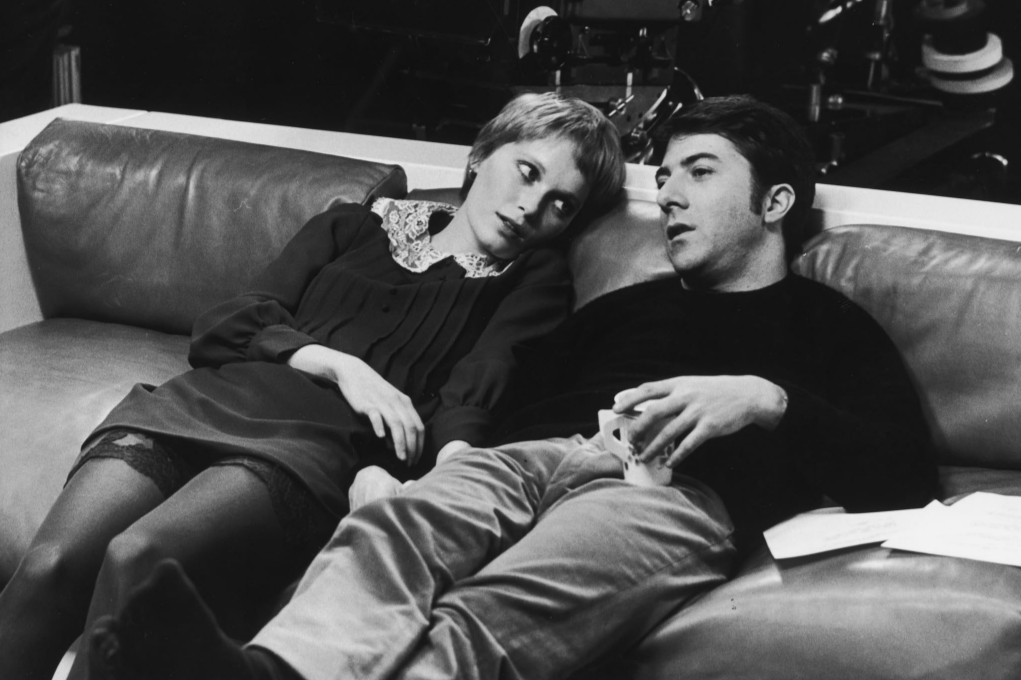
I also watched John and Mary the other night, a Peter Yates movie from 1969 with Dustin Hoffman and Mia Farrow. It's not a particularly good picture and, aside from a few temporal shifts, it's certainly not Godardian, but Godard is invoked early on in a scene where Hoffman [John] first meets Farrow [Mary] at a bar. He's making his way through the crowd, when he overhears a conversation about one of my favorite films, Weekend.

Dean - Whatever type of person made that movie must be sick in the head. Ten miles of traffic james and human beings eating each other in the bushes? He must be sick.

Fran - Maybe we're sick. Does that occur to you?

Dean - No it doesn't. It doesn't occur to me at all.

Mary - You blow your mind in traffic.

Dean - So, I blow my mind in traffic, but I don't eat my girlfriend.

Fran - I should be so lucky.

Dean - You know what I mean. I like a movie that has a beginning, a middle, and an end and in that order so you can follow it.

Mary - It's meant to be symbolic, Dean.

Dean - Pardon me?

Mary - I said it's meant to be...

Sensing a conversational opportunity, John interjects.

John - Symbolic. That's right. That's exactly what it's meant to be.

Mary - I beg your pardon?

John - I saw that movie at the film festival. I thought it was totally symobolic of our materialistic age.

Mary - Yeah, that's right. That's exactly what it is. Thank you very much.

John goes to fetch a round of drinks at the bar and Mary appears next to him.

John - I'm glad you liked that movie.

Mary - I didn't.

John - Really?

Mary - Not much. I just didn't like him not liking it.

Image of Mia Farrow and Dustin Hoffman from the IMDb.

Wednesday, April 4, 2007

Dead Objects Live On: Jean-Luc Godard's Two or Three Things I Know About Her

TWO OR THREE THINGS I KNOW ABOUT HER / 2 ou 3 Choses Que Je Sais d'Elle
(Jean-Luc Godard, France, 1966, 35mm, 90 minutes)


Right: Juliette Janson: housewife, zombie, robot, prostitute

Living people are often dead already.
--Narrator

By my count, I've seen 11 Godard films. I'm counting the monumental Histoire(s) du cinéma (1988-1998) series as one, just as I'm counting the short Letter to Jane: An Investigation About a Still (1972) as another (it's an extra on the Tout va bien DVD). I suppose that's a lot, although I've yet to see Les Carabiniers, Alphaville, Pierrot le fou, La Chinoise, Sympathy for the Devil, and Le Petit soldat. That's a lot, too, but once I've seen those six, I may call it a day as far as JLG is concerned.

Between 1960 and 1967, the director was on a roll. My favorites from this period include À bout de souffle (Breathless), Bande à part (Band of Outsiders), and Le Mépris (Contempt). Of course, they're important, influential pictures, but they're also terribly enjoyable -- despite the fact that all three end tragically. After that, his work becomes increasingly sour and schematic. The last film I caught was 2001's Éloge de l'amour (In Praise of Love), which has some lovely DV images, but turned me off the man for good. I found the shots at America, in general, and Steven Spielberg, in particular, mean-spirited. And it felt more like jealousy than genuine criticism.


Godard can be fun! (1964's Band of Outsiders)

This long-winded prelude is to say that I didn't much care for Two or Three Things I Know About Her, one of his most celebrated works. Maybe my expectations were too high. As J. Hoberman (The Village Voice) opines, it's "one of the top ten films of the 20th century." Now that I've read a bit about the movie, I appreciate it more, but I also think it marks the point at which the rot starts to set in. I'm not arguing that Godard didn't make any significant films afterwards, but his anti-American, anti-consumerist message starts to drown out character, story, and sense of fun.

Not only did I find my mind wandering during Two or Three Things, which isn't that long, but I felt like I was being hectored. Interestingly, Godard's voice of God narration is whispered rather than spoken. For some reason, I found that even more irritating. It's as if he were personally criticizing my vile materialistic ways.

Godard may not have felt the same about his intended audience, but he does feel that way about Juliette Janson (Marina Vlady, one of his least expressive leading ladies), who spends the entire time shopping, hanging out in coffee shops, and turning tricks. (The title refers as much to Paris as to automatons like Juliette.) Her husband appears to make a decent living, but she's just gotta have all those cute designer dresses. Other attractive young women pop up throughout to testify about the glories of consumer goods. All are dressed in the latest 1960s styles.

As Michael Guillén (The Evening Class) notes, "I found the film's maverick sensibility quaint, if that's a word that can be used with regard to Godard's iconoclastic adventures. Quaint and oddly nostalgic; dated enough to make it palatable but not so much so that I lost complete interest." Similarly, I didn't enjoy the film as essay, but I did appreciate it as a time capsule of a particular time, place, and mindset.

I don't doubt that many of those who hold Two or Three Things in high esteem enjoy it as much as they appreciate it, but for me any enjoyment was surface. I like the way the film looks, and the famous close-ups, like "the world in a coffee cup" sequence, are just as cool as I expected. (The widescreen images are credited to Godard regular Raoul Coutard.) And yes, I did find it amusing that Juliette's day care doubles as a brothel -- Godard's sense of fun hadn't completely abandoned him.

Peter Bradshaw (The Guardian) also feels that the "movie shows the great man apparently on the point of becoming unmoored from his early transparent approach to narrative and character, and drifting off downstream into the thickets of impenetrability and theoretical complexity." Phillip French adds that "the picture is alternately naive and sophisticated, silly and profound, and Godard's commentary:is an anti-American, anti-Gaullist and anti-capitalist diatribe." God, I love the British.

I've been making an effort to see all the major movies, so Two or Three Things counts as one down, hundreds to go. Once I've seen it again -- assuming I can muster the enthusiasm -- I'll probably appreciate it more. Maybe I'll even enjoy it. I just don't think watching films should feel like work. And after being hectored for 90 minutes about being a brain-dead consumer, it just made me want to go shopping.

Pax Americana: jumbo-sized brainwashing.
-- Narrator

Two or Three Things I Know about Her, in a new 35mm CinemaScope print, plays Northwest Film Forum through April 5th at 7 and 9pm. The NWFF is located at 1515 12th Ave. For more information, call (206) 329-2629 for general info or (206) 267-5380 for showtimes. Image from the IMDb.